What is Long Short Ratio and How to Use it for Crypto Futures Trading?

The long/short ratio compares the number of traders (or the value of open positions) holding long positions against those holding short positions in a crypto futures market. A long/short ratio above 1 signals bullish sentiment; a ratio below 1 signals bearish sentiment. It's a sentiment indicator, not a price predictor, and works best alongside funding rates, open interest, and technical analysis.
Over 420 million people own crypto in the world right now, and crypto is, without a doubt, the talk of the hour for investors. The best part of the asset class is that while you can do some straightforward spot trading, you can also get up on platforms like Delta Exchange to trade in crypto derivatives- the likes of crypto futures and options. And if crypto futures is your cup of tea, for instance, you would need the knowledge of the long short ratio to cash in on the instrument just right.
What is the long to short ratio? The understanding begins at knowing the answer to ‘what is long position and short position?’
What is Long Position and Short Position?
A long position is a bet that a crypto's price will rise - economically similar to buying in the spot market. A short position is a bet that price will fall, economically similar to selling an asset you don't yet own. The long short ratio is built directly from the balance between these two types of positions.
You may have heard terms like 'shorting Bitcoin' used by traders before. Long and short positions in crypto futures are opened based on the direction a trader expects the market to move:
- Long position: Opened when a trader expects prices to rise.
- Short position: Opened when a trader expects prices to fall.
You can think of a long position as economically similar to buying crypto, and a short position as economically similar to selling it. When most traders lean long, it usually reflects bullish sentiment; when more traders lean short, it usually reflects bearish sentiment - this is exactly what the long short ratio measures.
Long Position vs Short Position: Key Differences
Here’s a quick look at long position vs short position against each other:
Because the loss profile of a short position is open-ended, short sellers face outsized risk if the price of an asset moves against them significantly.
What is the Long Short Ratio in Crypto Futures?
You may have an idea already, but the long to short ratio basically shows the strength of bullish or bearish feelings in the market. It is one of the sentiment analysis indicators regularly checked by both rookie and pro traders to gauge how the broader market feels about a certain crypto.
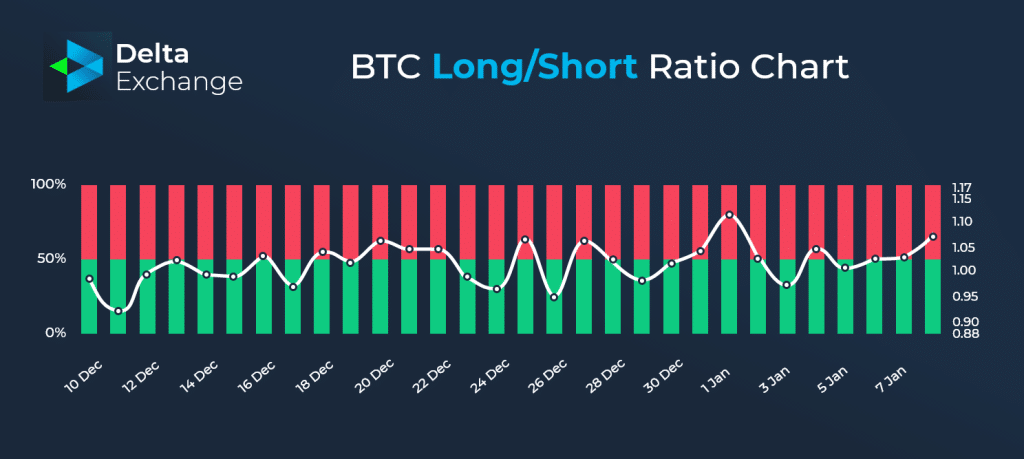
If you take a look at the figure above, this is what a typical long to short ratio chart looks like. If you look carefully, in terms of shorts vs longs, there are some 24 hour candles with more green, while some are more red. The more red candles show a day with bearish sentiments as per long to short ratio reading, while the more green candles show a bullish day as per long short ratio. As you can see, due to various macroeconomic factors, the broader market sentiment shifts everyday, resulting in shifting long short ratios as well. The significance of the long short ratio is high for crypto future traders:
- A long to short ratio above 1 stands for bullish sentiments, while a long short ratio below 1 shows dominance of the bears.
- You may argue that a majority vote does not automatically imply they are correct, and you’d be right, because in many cases wrong opinions spread massively because of FOMO (fear of missing out) and FUD (fear, uncertainty, and doubt). However, even when you use other technical indicators to more precisely gauge the future of the market, you must take the long short ratio into account for the short term. This is because public sentiment is in large part responsible for affecting a crypto’s prices as the value of digital currencies depends on their perceived value by the users in the absence of a centralized backing.
How is the Long to Short Ratio Calculated?
The long short ratio formula divides the number (or value) of long positions by the number (or value) of short positions: Long/Short Ratio = Total Long Positions ÷ Total Short Positions. A ratio of 2, for example, means there are twice as many long positions as short positions in that market.
For example, if a market has 30 long positions against 15 short positions, the long to short ratio is 2 (30 ÷ 15 = 2). A ratio above 1 signals more long positions relative to shorts (positive sentiment); a ratio below 1 signals more short positions relative to longs (negative sentiment).
Exchanges commonly report this ratio using one of three methodologies, and it's worth knowing which one a data source is using before drawing conclusions:
- Account ratio: Counts the number of unique accounts holding long vs. short positions.
- Position ratio: Counts the number of individual long vs. short positions, regardless of account.
- Notional value ratio: Compares the total dollar (or token) value of long vs. short positions.
These methods can diverge, a market can show more long accounts by count while short positions dominate by value, for example pairing the ratio with volume and open interest data gives a clearer picture.
How to Use the Long/Short Ratio Indicator in Trading
Traders use the long short ratio indicator alongside price action, funding rates, and open interest — not on its own. Rising prices with a rising long short ratio suggests broad conviction behind a move. Rising prices with a falling ratio (more shorts building) can signal a potential short squeeze, since short positions may be forced to close as losses mount.
A few practical ways traders apply the long/short ratio indicator:
- Confirming trend strength: A rising ratio alongside rising prices suggests the trend has broad support.
- Spotting divergences: If price rises while the ratio falls (shorts increasing), it can flag brewing volatility or a possible short squeeze.
- Reading extremes as contrarian signals: Very high or very low ratios often mean a trade is "crowded," which can make it more vulnerable to a sharp reversal when sentiment flips.
- Cross-checking with funding rates: On perpetual futures, a heavily long market typically pushes funding rates positive, meaning long position holders pay short position holders to keep their trades open - an added cost that can eventually push some longs to close.
Long/Short Ratio vs Other Sentiment Indicators
The long short ratio is one of several sentiment and positioning tools crypto futures traders monitor. It's most useful in combination with:
Limitations of the Long/Short Ratio
The long short ratio is a sentiment proxy, not a price predictor, and it has real limitations:
- Exchange-reported positioning data can be incomplete or vary between account, position, and notional-value methodologies.
- Large players can influence the ratio without reflecting genuine broad-market sentiment.
- It says nothing about position size, leverage, or entry price, factors that matter as much as direction.
For these reasons, experienced traders treat the long short ratio as one input among several, not a standalone signal.
Conclusion
So what's the takeaway? The long to short ratio tells you, at a glance, whether crypto futures traders are leaning bullish or bearish over a given period - above 1 and the crowd is long, below 1 and it's leaning short. That's genuinely useful. But a crowd isn't always right. FOMO and FUD sway positioning all the time, and the data exchanges report isn't perfect either. So don't trade off the ratio alone - pair it with funding rates, open interest, and your own technical and fundamental read before you actually put a crypto futures trade on.
Frequently Asked Questions (FAQs)
Q1. What is the long short ratio in crypto futures trading and what does it indicate?
Answer: It's a simple comparison: how many traders are holding long positions in a futures market versus how many are short. When that number climbs above 1, longs outnumber shorts and sentiment is leaning bullish. Drop below 1 and shorts have the upper hand. Think of it as a mood gauge for the market, not something that tells you where price is headed next.
Q2. How is the long short ratio calculated in cryptocurrency markets?
Answer: Exchanges calculate it by dividing open long positions by open short positions, either by account count or by notional value. These two methods often diverge and can point in opposite directions, so it is worth checking which method a given data source is using before drawing conclusions.
Q3. What does a long short ratio above or below 1 mean in trading sentiment?
Answer: Above 1 means more traders are positioned long, signalling bullish sentiment. Below 1 signals bearish positioning. Extremes in either direction tend to work as contrarian signals because crowded trades are the most vulnerable when the market moves against consensus.
Q4. How do traders use the long short ratio to analyze bullish or bearish market trends?
Answer: Traders cross-reference it with price action. Rising price plus rising longs suggests broad conviction. Rising prices alongside growing shorts means sellers are fighting the trend, which also pushes up funding rates on perpetuals and raises the risk of a short squeeze. Divergences are worth watching closely.
Q5. Can the long short ratio be used as a standalone indicator for trading decisions?
Answer: No. It is a sentiment proxy, and exchange-reported positioning data can be incomplete or gamed by large players. Treat it as one input among several. Funding rates, open interest, volume, and technical levels together give a more reliable read of where the market actually is.
Q6. How does market sentiment affect long and short positions in crypto futures trading?
Answer: Fear pushes traders into shorts; greed piles them into longs. On perpetuals, a heavily long market generates positive funding, meaning long holders pay shorts to stay open. This creates a built-in incentive for counter-positioning. Delta Exchange traders can track funding rates alongside the long/short ratio to time entries more effectively.