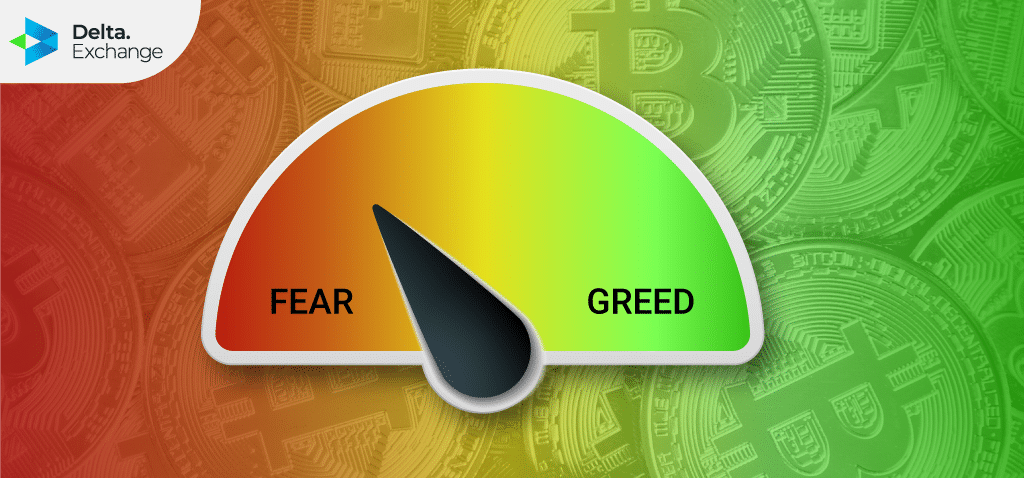
What is Crypto Fear and Greed Index and how does it work?

The cryptocurrency market is highly volatile. In November 2021, it was on the verge of a tremendous bull run, with digital currencies reaching all-time highs in an unprecedented market. In such a situation, when the market is on the rise, people become greedy, resulting in FOMO (Fear of missing out).
On the other hand, investors can start selling their currencies irrationally if they see too many red numbers. Both of these can result in a direct hit on the stability of portfolios. The Fear and Greed index is one measure of the market's state. It was launched at Alternative.me. While measuring and judging the crypto market can be tricky, these indices can give you a fair idea by tracking cryptocurrencies as it swivels from deep lows and highs. The index is made up of two opposing emotions: fear and greed. It reflects whether the market is bullish (markets experiencing sustained increase) or bearish (markets suffering sustained decrease). Extreme anxiety indicates that investors are too concerned about an opportunity to purchase, whereas excessive greed indicates that the market is due for a correction. The index's main principle is that when investors are frightened, stock prices will trade far lower than their true value, and when investors are greedy, they will pay well over the stock's intrinsic value. Please keep in mind that this index does not forecast price changes. Even at the extreme extremes of the scale, low numbers do not invariably precede declines or high number increases. Most of the time, these indicators reflect what has already transpired. Let us look at an example of this. The price of one Bitcoin was slightly under $57,000 on May 11th of this year. The FOMO Index was at 61, which was halfway between "Neutral" and "Greed." BTC fell to $49,500 on the 12th. A decrease of 13% marked one of the worst 24-hour periods of the year in severity. Meanwhile, the FOMO Index had risen to 68. Only the next day, as a result of the price drop, did sentiment change. The 22nd and 23rd of February showed a roughly identical pattern. The same event happened on April 25th and 26th but in the opposite direction. It holds whether you measure in weeks or months. The fear and greed indices follow the crypto.
Calculation of the Fear and Greed Index
The index ranges from 0 to 100.Investors with a score of 0 are too bearish or afraid, while those with a score of 100 are overly optimistic and greedy. The score categories can be divided into the following:
- Extreme Fear : 0-24
- Fear: 24-49
- Neutral: 50
- Greed: 51-74
- Extreme Greed: 75-100
What are the sources of Data?
To illustrate significant progress in the crypto market's attitude change, each data point is valued the same as the day before. Currently, the index only provides the trends of Bitcoin with a promise to include other large altcoins soon.Alternative.me uses the following factors or sources to measure the index. They are:
- Volatility (25 %)
- Market Momentum/Volume (25%)
- Social Media (15%)
- Surveys (15%) currently paused
- Dominance (10%)
- Trends (10%)
Conclusion
The Fear and Greed index efficiently gauges investors' sentiments toward the market and provides them with a simplified view of how the market is performing. Although there are varying views on the efficiency of the crypto fear and greed index, it accurately indicates significant changes in the history of the coin. Investors generally believe that the index is a good instrument for assessing markets as long as it is not utilized as the sole tool for making decisions and conducting your research. No tool developed today or tomorrow can present you with a full proof picture of market trends, especially Cryptocurrencies. It's better to curb the rising sense of FOMO and do proper research.
Frequently Asked Questions (FAQs)
Q1. What is the Crypto Fear and Greed Index?
Answer: The Crypto Fear and Greed Index, published by Alternative.me, scores Bitcoin market sentiment daily on a 0 to 100 scale. A score near 0 signals extreme fear, while 100 signals extreme greed, giving traders a quick read on whether the market is panicking or overheating.
Q2. How is the Fear and Greed Index calculated?
Answer: The index combines five weighted inputs: price volatility (25%), market momentum and volume (25%), social media sentiment (15%), Bitcoin dominance (10%), and Google Trends data (10%), with remaining weight distributed across supplementary signals. Each input is compared against historical averages to produce the final score.
Q3. What are the score categories and what do they mean?
Answer: Scores from 0 to 24 indicate extreme fear, 25 to 49 fear, 50 neutral, 51 to 74 greed, and 75 to 100 extreme greed. The index hit single digits during the 2022 LUNA and FTX crises and climbed above 80 during the 2024 post-halving bull run.
Q4. How does FOMO affect crypto market behavior?
Answer: FOMO pushes retail investors to buy during greed phases, often near local tops, creating a self-reinforcing price surge. When sentiment flips, the same crowd panic sells, deepening corrections. The Fear and Greed Index makes this cycle visible and encourages traders to pause before following the crowd.
Q5. What is the difference between extreme fear and extreme greed?
Answer: Extreme fear suggests the market is oversold and sentiment may be worse than fundamentals justify, which contrarian traders treat as a buying signal. Extreme greed suggests speculative excess and a possible correction ahead. Neither is a guarantee, just a prompt to question whether you are trading the trend or the hype.
Q6. What are the limitations of the Fear and Greed Index?
Answer: The index is Bitcoin-focused and often misses altcoin sentiment shifts. It is coincident rather than predictive and can be thrown off by macro shocks, regulatory news, or algorithmic trading. On Delta Exchange, traders use it alongside technical analysis and open interest data rather than as a standalone signal, with BTC and ETH perpetuals available for acting on sentiment in either direction.