What is Inverted Cup and Handle Chart Pattern?

The inverted cup and handle is a bearish reversal chart pattern shaped like an upside-down bowl (the cup) followed by a small upward drift (the handle). It forms after an uptrend and signals that sellers are taking control. Traders typically open a short position once price breaks below the handle's support, placing a stop-loss above the handle high and a target roughly equal to the cup's depth.
A chart pattern forms when the price of an asset moves in a way that mirrors a recognizable shape - a triangle, a head and shoulders, or a rounded bowl. These patterns give traders a visual shorthand for spotting logical entry points, stop-loss levels, and risk-to-reward setups without relying on guesswork.
One of the best-known patterns is the cup and handle pattern, first described by William O'Neil in How to Make Money in Stocks. It signals a bullish continuation. Its mirror image, the inverted cup and handle pattern, signals a bearish continuation and is one of the more reliable sell signals available to crypto traders.
Like the standard version, the inverted pattern has two parts: an upside-down cup, followed by a smaller handle that forms on the right-hand side once the cup completes.
What is the Inverted Cup and Handle Pattern?
The inverted cup and handle pattern is a bearish chart formation that appears after a sustained uptrend. It gets its name from its shape: an upside-down, rounded bowl (the cup) followed by a short upward consolidation (the handle) before price breaks down.
It appears across all timeframes, from one-minute charts used by day traders to weekly and monthly charts used for swing and position trading, which makes it one of the more versatile bearish setups in crypto technical analysis.
How to Identify an Inverted Cup and Handle Pattern
Inverted vs. Regular Cup and Handle Pattern
How to Trade the Inverted Cup and Handle Pattern (Step by Step)
- Confirm the setup: Make sure the pattern follows a genuine uptrend and shows a clean, U-shaped cup, if you have to talk yourself into the shape, skip the trade.
- Watch the handle form: Volume should be declining daily as the handle drifts upward; this is your early warning that a breakdown is likely.
- Wait for the breakdown: Enter a short position once price closes below the handle's support/trendline, ideally on volume higher than the 10-day average.
- Set your stop-loss: Place it just above the handle's high (or on the ascending trendline of the handle) to cap losses if the breakdown fails.
- Set a price target: A common approach is to project a move of 20%–50% of the cup's depth downward, while acknowledging price can retrace back into the handle and invalidate the setup.
- Size the position: On Delta Exchange, traders can use futures or options to take a short position without holding the underlying asset, which also allows hedging an existing spot position.
Examples of Cup and Handle Pattern
Example 1:
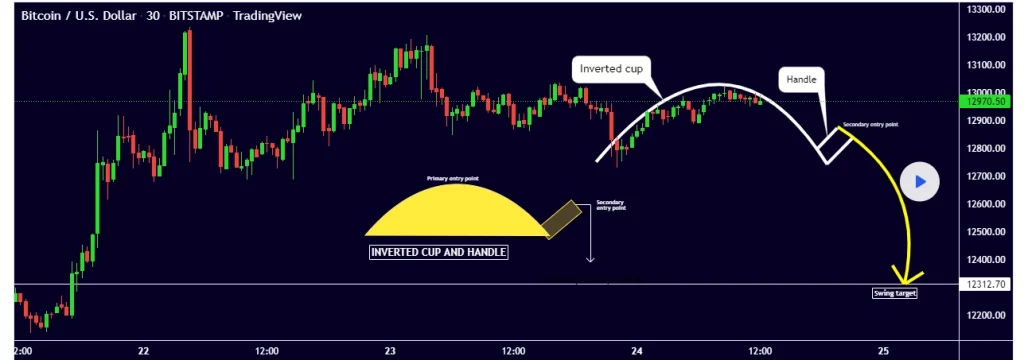
The chart above shows Bitcoin entering an inverted cup and handle formation on October 4, 2020. This pattern indicates a clear sign of the bearish phase. The pattern was predicted in a lower timeframe, and the downward move was limited to particular points. There are two opportunities for the traders here - one is from the bottom of the cup, and the second is after the minor rebound correction occurring in handle formation.
Example 2:
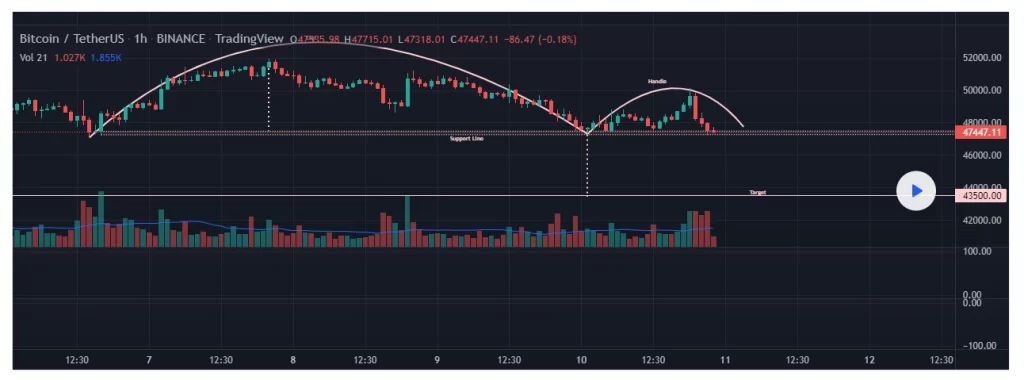
This inverted cup and handle pattern formed on an hourly timeframe was observed in BTC/USDT pair on December 10, 2021.
Limitations and What to Watch For
Conclusion
Traders should remember that an inverted cup and handle chart pattern helps you get the best bets in going short when it occurs right after a clear uptrend. Derivatives trading with Delta Exchange allows you to speculate on upward and downward price movements or go long and short without actually buying the asset and helping you hedge against market volatility. You can set up your Delta trading account in a few easy steps and start placing your bets as and when you recognize an inverted cup and handle chart pattern or, in the case of other kinds of chart patterns.
FAQS
#1 How do you recognize an inverted cup and handle pattern?
Ans: The cup and handle pattern is easy to recognize. Once you set your scanner to address other trading needs, you can look through the results and find a chart that resembles large crescent shapes followed by a less extreme uptrend. If the cup shape isn’t a classic U and you are in two minds, avoid putting any odds on the forming pattern.
#2 When should we sell in case of an inverted cup and handle pattern?
Ans: In the case of an inverted cup and handle pattern, you should consider selling under two conditions. Once when you witness a daily drop in the volume for several days or when you find the partial retracement of the original uptrend complete signalling the end of the handle formation as well as the end of the bull run. Other factors that you can consider while setting a target include - uptrend or downtrend in a larger time frame and increasing or decreasing volatility.
#3 Can we buy an inverted cup and handle pattern within the trading range?
Ans: Yes, you can buy when the cryptocurrency price makes a new low outside the bottom of the inverted cup. The buy point here is the short momentum signal. You need to enter a short position as soon as the price breaks down out of the handle pattern. You can also set up a stop-loss on the ascending trendline of the inverted handle.
#4 How can we set a price target in an inverted cup and handle pattern?
Ans: You can set your price target to the downside anywhere between 20% to 50%. But the traders should be careful and note that the target can go lower further and can also rise back in price into the inverted handle and fail.
#5 Why do we need stop-loss in an inverted cup and handle chart pattern?
Ans: When the price moves out of the inverted cup and handle pattern, the price is expected to fall. This doesn’t mean the price can’t go up or move sideways. To hedge against all probabilities, a stop-loss order is needed.
#6 Where should we place a stop-loss order in the chart pattern?
Ans: The stop-loss order should be placed at the same time when you enter a short position. Setting the stop-loss at this position helps you limit your losses or ‘lock in’ any potential profits.