Deep OTM/ITM Options: An Overview of What They Are and How They Work

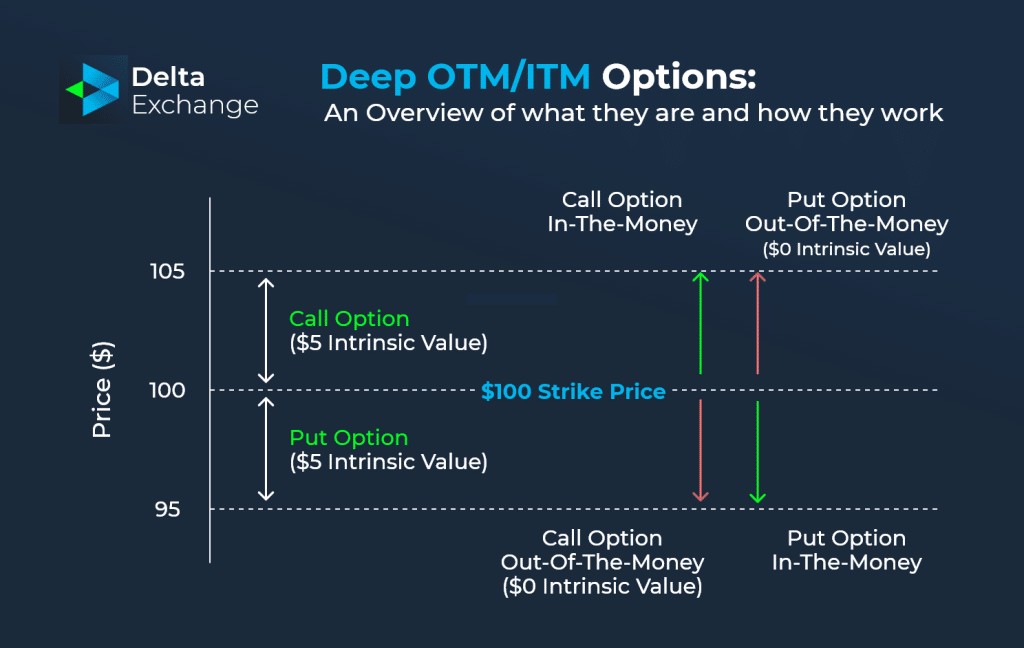
ITM (in the money) options already have intrinsic value - a call with a strike price below the market price, or a put with a strike price above it. OTM (out of the money) options have no intrinsic value and are made up entirely of time value - a call with a strike above the market price, or a put with a strike below it. ITM options cost more but carry lower risk of expiring worthless; OTM options cost less but are more speculative.
Options trading offers a diverse range of strategies to investors, including the intriguing realm of deep in the money (ITM) and deep out of the money (OTM) options. If you've searched for OTM meaning in trading or ITM meaning in trading, this guide breaks both down in plain terms, along with how an out of money call option or an out the money option is priced. These options, with their unique characteristics and risk-reward profiles, provide opportunities for traders seeking leveraged positions and potential profits. In this blog post, we will delve into the world of deep ITM and OTM options, exploring how they work, understanding their mechanics, discussing OTM trading strategies, and uncovering their utilization on Delta Exchange. Join us on this journey to gain insights into these fascinating options and enhance your trading knowledge.
What is OTM Meaning in Trading?
OTM meaning in trading refers to an option that has no intrinsic value at the current market price. A call option is out of the money when its strike price sits above the market price; a put option is out of the money when its strike price sits below the market price. An out of the money option derives its entire premium from time value, which is why it is cheaper but riskier than an in the money option.
What is ITM Meaning in Trading?
ITM meaning in trading describes an option that already has intrinsic value at the current market price. A call option is in the money when its strike price sits below the market price; a put option is in the money when its strike price sits above the market price. In the money options behave more like the underlying asset itself, especially deep ITM options, whose delta approaches 1.
What are Deep ITM Options?
Deep in the money (ITM) options refer to options contracts that have a strike price significantly lower (for call options) or higher (for put options) than the current market price of the underlying asset. These options possess a high intrinsic value and minimal extrinsic or time value. As a result, their prices closely track the movements of the underlying asset, with deltas approaching or even reaching 1. This means that for every point change in the underlying asset's price, the deep ITM option's price changes in the same direction, almost in lockstep. Deep ITM options offer several advantages to traders. They provide a leveraged exposure to the underlying asset, similar to owning the asset itself but with lower capital outlay and limited risk. This leverage amplifies potential profits when the underlying asset moves favorably. Additionally, deep ITM options have a high probability of expiring in the money, making them attractive to long-term investors.
Understanding How Deep ITM Options Work
The value of a deep ITM option primarily consists of its intrinsic value, which is the difference between the underlying asset's market price and the strike price. For a call option, the intrinsic value is calculated by subtracting the strike price from the market price, while for a put option, it is determined by subtracting the market price from the strike price. The remaining component of the option's value is its time value, which diminishes as the option approaches its expiration date. Deep ITM options behave more like the underlying asset itself due to their high deltas. They closely mirror the price movements of the underlying asset, making them an effective tool for capturing directional movements in the market. Traders can use deep ITM options to gain exposure to the underlying asset at a fraction of the cost, thereby magnifying their potential returns.
Trading Strategies for Deep ITM Options
Deep ITM options offer various crypto trading strategies depending on market outlook and individual trading goals. Here are a few common strategies:
- Leveraged Long Position: Buying deep ITM call options allows traders to gain leveraged exposure to the underlying asset's upside potential. As the underlying asset's price rises, the deep ITM call option's value increases, resulting in amplified profits.
- Covered Call Strategy: Investors who already own the underlying asset can sell deep ITM call options against their holdings, generating income from the option premiums. This strategy allows traders to benefit from the underlying asset's price appreciation while collecting option premiums.
- Protective Put Strategy: Traders who hold a significant long position in the underlying asset can purchase deep ITM put options to provide downside protection. If the underlying asset's price declines, the put option's value increases, offsetting potential losses on the long position.
- Synthetic Stock Position: Combining deep ITM call options with deep ITM put options can replicate the behavior of owning the underlying asset, providing a cost-effective alternative to direct ownership.
What are Deep OTM Options?
Deep out of the money (OTM) options are options contracts that have a strike price significantly higher (for call options) or lower (for put options) than the current market price of the underlying asset. An out of money call option in this category has essentially no intrinsic value - the entire premium is time value. Due to their low likelihood of expiring in the money, deep OTM options are considered more speculative in nature.
Understanding How Deep OTM Options Work
Deep OTM options derive their value mainly from the expectation that the underlying asset's price will move significantly in the desired direction before the option's expiration. These options have low deltas, meaning their prices are not as sensitive to small changes in the underlying asset's price compared to deep ITM options. As a result, deep OTM options require larger price movements in the underlying asset for their values to appreciate. Deep OTM options are typically purchased with the anticipation of a substantial price move in the underlying asset. Traders who believe that the asset's price will experience a significant upward or downward movement may choose to buy deep OTM call or put options, respectively, in the hopes of capturing substantial gains if their price predictions come true.
Trading Strategies for Deep OTM Options:
Deep OTM options are often used for speculative purposes or as part of more complex OTM trading strategies. Here are a few strategies commonly associated with deep OTM options:
- Long Shot Strategy: Traders purchase deep OTM options with the expectation of a large price move in the underlying asset. Although the likelihood of the option expiring in the money is low, the potential reward can be substantial if the anticipated price move occurs.
- Lottery Ticket Strategy: Similar to the long shot strategy, traders buy deep OTM options at a low cost, hoping for an extraordinary price move that would result in a significant profit. This strategy involves accepting a higher level of risk for the possibility of a substantial return.
- Options Spreads: Traders can utilize options spreads involving deep OTM options to create complex strategies that benefit from specific market conditions, such as low volatility or range-bound markets. Examples include vertical spreads, butterfly spreads, or condor spreads.
- Hedging Strategies: Deep OTM options can be used as part of a hedging strategy to protect against adverse price movements in the underlying asset. Traders may purchase deep OTM put options to hedge against potential downside risk in their existing positions.
It is important to note that trading deep OTM options carries a higher level of risk due to their low probability of expiring in the money. These options may experience rapid value erosion as they approach their expiration dates.
OTM Options vs ITM Options: Key Differences
The table below summarizes the core differences between OTM options and ITM options across intrinsic value, cost, delta, and risk profile.
Final Word
When trading deep ITM options, you can benefit from their high intrinsic value, which closely mimics the price movement of the underlying asset. On the other hand, deep OTM options can be used for speculative plays, capitalizing on significant price swings and potential for outsized returns. It's crucial to consider your risk tolerance, market conditions, and investment goals when incorporating deep ITM or OTM options into your trading strategy. Remember to conduct thorough analysis, monitor market trends, and stay informed about the factors affecting the underlying asset's price.
FAQs
Q1: What are deep OTM and ITM options?
Answer: Deep OTM options are like long shots - their strike price is far from where the market currently sits, making a profitable expiry unlikely. Deep ITM options are the opposite: the strike is already well in your favour, giving them real, built-in value. Delta Exchange offers both on BTCUSD and ETHUSD with daily and weekly expiries.
Q2: What is the difference between OTM and ITM options?
Answer: ITM options already have intrinsic value - the market price is working in your favour. OTM options carry no intrinsic value, only time value, making them cheaper but riskier. The further an option sits from the current price, the more extreme its delta becomes - approaching zero for deep OTM and near 1 for deep ITM calls.
Q3: Why do traders use deep OTM options?
Answer: They are affordable and carry outsized upside if things go your way. A modest premium can return multiples if the underlying moves sharply. Traders often reach for deep OTM options ahead of high-impact events - a Bitcoin halving, a major macro announcement - or simply to buy low-cost protection against unlikely but damaging price swings.
Q4: Why are deep ITM options considered safer?
Answer: Deep ITM options move almost in lockstep with the underlying asset, thanks to a delta close to 1. Most of their value is intrinsic - real, not speculative - so they are far less vulnerable to time decay eating away at your position. For traders who want options exposure without the anxiety of watching premiums erode daily, deep ITM is a steadier choice.
Q5: Which option moves more - ITM or OTM?
Answer: It depends on what you mean by “move.” Deep OTM options can deliver triple-digit percentage returns on a relatively small price shift - but they can just as quickly go to zero. Deep ITM options deliver stronger absolute gains because their delta is near 1. Prefer leverage and speculation? Go OTM. Prefer stock-like exposure with options efficiency? ITM is your answer.
Q6: What is an out of money call option?
Answer: An out of money call option is a call whose strike price is above the current market price of the underlying asset. It has no intrinsic value, only time value, so it is cheaper to buy than an in the money call - but it only becomes profitable if the underlying asset's price rises above the strike before expiry.
Q7: What is an out the money option, and how is it priced differently from an ITM option?
Answer: An out the money option is priced using time value alone, since it has no intrinsic value at the current market price. An ITM option, by contrast, is priced using both intrinsic value and time value, which is why ITM options generally carry a higher premium and a delta closer to 1.