Why XRP's $116 Billion Market Just Got Its First Real Staking Protocol: Firelight

Despite commanding a market capitalization of approximately $116 billion and ranking among the top five cryptocurrencies globally, XRP has remained conspicuously absent from the staking revolution that has swept through digital assets. That changed in early December when Firelight, a new DeFi protocol (and there’s a ton of activity in the space lately - like DeFi Mullet), launched what it calls a fundamentally different approach to both XRP staking and decentralized finance insurance.
The timing is deliberate. According to CoinDesk, the DeFi sector - with all its use cases - loses over $1 billion annually to exploits and hacks, yet institutional adoption continues accelerating, with total value locked surpassing $170 billion in October. Firelight positions itself at this intersection, addressing two problems simultaneously: XRP's lack of yield opportunities and DeFi's glaring insurance deficit.
The Structural Problem with XRP
XRP's inability to generate yield stems from its fundamental architecture. Unlike proof-of-stake networks such as Ethereum, the XRP Ledger employs a Federated Consensus mechanism that requires no staking. This design prioritizes speed and energy efficiency but leaves XRP holders without native earning mechanisms. The XRP Ledger's total value locked stands at just $72 million, according to DefiLlama, a fraction of what comparable networks command.
The implications extend beyond individual holders. Outside of Bitcoin ETFs, Institutional investors increasingly demand yield-bearing assets. Without staking capabilities, XRP struggles to compete for capital against alternatives offering 5 to 10 percent annual returns. This structural disadvantage has arguably limited XRP's integration into broader DeFi ecosystems despite its substantial market presence.
Firelight's Dual-Purpose Architecture
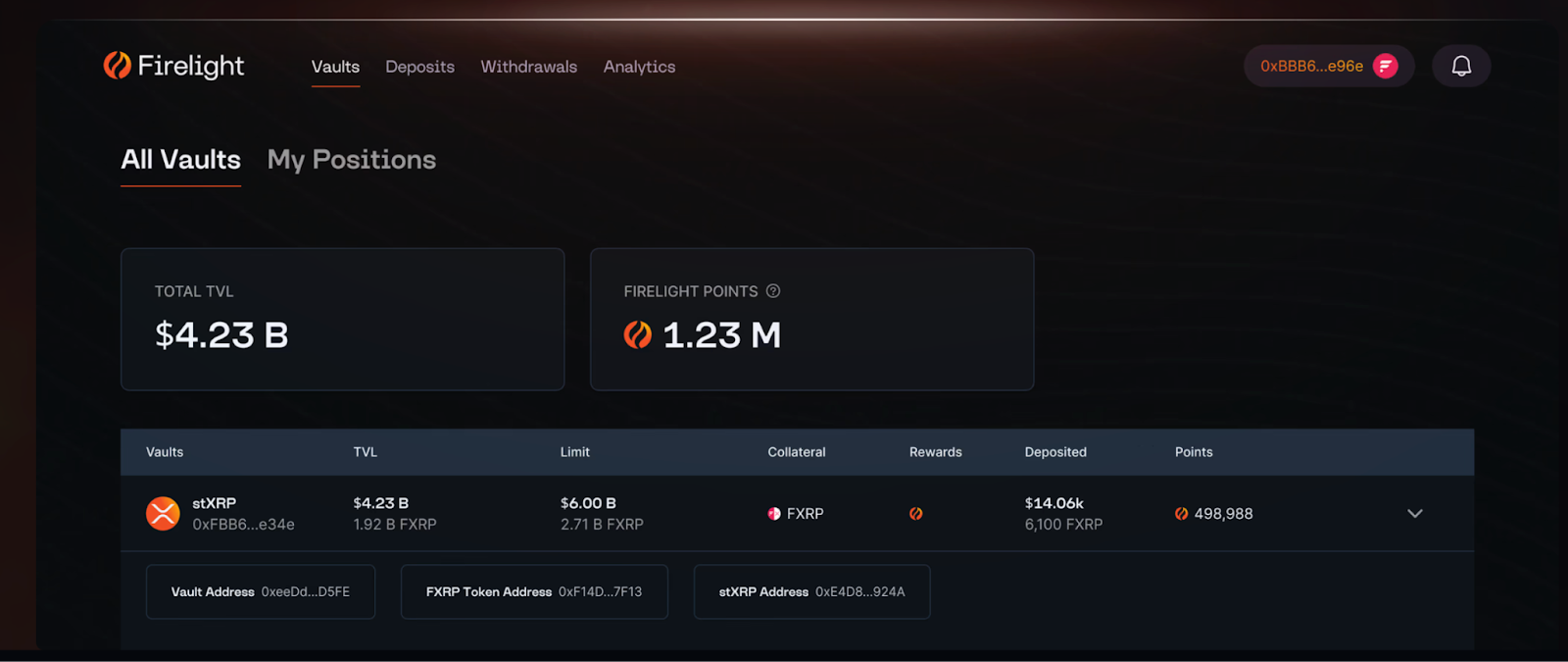
Built by Sentora and backed by Flare Network, the Firelight staking protocol operates through a two-phase mechanism. Users deposit XRP through Flare's FAssets bridging system, receiving FXRP, which they can stake to obtain stXRP, a liquid ERC-20 token representing their position. This stXRP remains freely tradable across Flare's DeFi ecosystem while the underlying assets back an insurance pool.
Phase Two, scheduled for early 2026, activates the insurance layer. Staked XRP underwrites protection for DeFi protocols against smart contract exploits, oracle failures, and bridge vulnerabilities. Protocols purchasing this coverage pay fees that generate returns for stakers.
Connor Sullivan, Firelight's chief strategy officer and former Fireblocks executive, told The Block that the model deliberately targets assets with lower opportunity costs. Rather than competing with established Ethereum yields, Firelight focuses on providing institutional-grade risk infrastructure that traditional DeFi protocols lack but increasingly demand.
The Insurance Gap DeFi Cannot Ignore
Traditional finance embeds insurance into every market layer. Deposits carry federal guarantees. Securities trades settle through clearinghouses with substantial capital backstops. DeFi, despite its institutional ambitions, operates largely without comparable protections. Recent high-profile exploits, including the Balancer incident, have intensified concerns about asset safety even as institutional capital flows accelerate.
Firelight's insurance mechanism addresses this structural weakness. By creating economic incentives for risk underwriting, the protocol attempts to establish a self-sustaining protection layer that grows alongside DeFi adoption. The model's viability, however, depends entirely on whether major protocols actually purchase coverage at rates sufficient to reward stakers adequately.
Risks and Market Realities
Early participants in Firelight's launch vault receive points tied to future protocol economics, though specific tokenomics remain undisclosed. More significantly, staking rewards will not activate until Phase Two launches and protocols begin purchasing insurance. This creates execution risk: if adoption falters, stakers may hold liquid tokens without meaningful yield.
Additionally, the insurance model faces uncertain demand. While institutional players express interest in DeFi risk management, price sensitivity could limit uptake. Sullivan acknowledged that success requires finding "fair balance" between staker returns and coverage costs for purchasing protocols.
The broader implication transcends Firelight itself. If successful, the protocol demonstrates how underutilized assets can bootstrap new financial infrastructure. If it struggles, the failure may signal that DeFi insurance markets remain premature despite apparent institutional demand.
For XRP holders accustomed to price speculation as their primary engagement mechanism, Firelight represents a material shift toward productive capital deployment. Whether that shift catalyzes meaningful change in XRP's DeFi integration or remains a marginal innovation will become clear throughout 2026 as Phase Two unfolds and market dynamics clarify.
Frequently Asked Questions (FAQs)
Q1. What is the Firelight XRP staking protocol?
Answer: Firelight is a DeFi protocol on Flare Network, incubated by Sentora, that lets XRP holders stake and earn yield. Users bridge XRP to Flare as FXRP via the FAssets system, deposit into a Firelight vault, and receive stXRP, a liquid ERC-20 token representing their staked position.
Q2. Why doesn't XRP support native staking like other cryptocurrencies?
Answer: The XRP Ledger uses a consensus protocol rather than proof-of-stake, so there is no native staking mechanism or validator reward structure for token holders. Unlike ETH or SOL, XRP generates no yield simply by being held on-chain. Firelight routes XRP into Flare's smart contract environment to deploy it productively.
Q3. How does Firelight generate yield for XRP holders?
Answer: Staking rewards are not yet live. Phase 2, now targeted for Q2 2026, will activate DeFi cover: DeFi protocols pay fees to purchase protection backed by pooled FXRP, and a share flows to stakers. Rewards depend entirely on whether protocols adopt the insurance model and actually pay for coverage.
Q4. What role does DeFi insurance play in the Firelight model?
Answer: DeFi protocols integrating Firelight can buy on-chain cover against smart contract exploits, oracle failures, and bridge risks. Over $1 billion is lost annually to DeFi hacks, and this insurance primitive addresses that gap directly. Claims go to an independent consortium for review, then payouts execute automatically via on-chain contracts.
Q5. What are the risks of staking XRP through Firelight?
Answer: Key risks include bridge exposure when converting XRP to FXRP, smart contract risk on Flare, and an unbonding period on unstaking. The larger structural risk is that staking rewards only materialise if DeFi protocols buy cover in Phase 2. For direct XRP exposure, Delta Exchange offers INR-settled perpetual contracts.