
What Is Pepe Coin? A Complete Beginner's Guide to PEPE Crypto

Pepe coin (PEPE) is a memecoin on Ethereum, named after the viral Pepe the Frog cartoon. It launched in April 2023 with no presale or transaction tax, and a fixed supply of 420.69 trillion tokens.
In this guide, I’ll cover how Pepe coin works, where it came from and what to watch before you trade it.
Key Takeaways
- PEPE is an ERC-20 token on Ethereum, launched in mid-April 2023 as a tribute to the Pepe the Frog meme.
- Total supply started at 420.69 trillion tokens. About 6.9 trillion were burned in October 2023.
- There's no transaction tax, no staking, no governance voting and no automatic burn on trades.
- The all-time high was about $0.00002803 in December 2024, according to CoinGecko.
- Canary Capital has filed for a US spot PEPE ETF. As of late October 2026, the SEC hadn't approved it.
What is Pepe Coin Again?
PEPE is like a digital collectible that trades similar to a currency. That’s essentially what memecoins are. You can send it, swap it and hold it in any Ethereum wallet, but it doesn't power an app or earn you a share of anything.
Here's what that means in practice:
No utility by design: It is a meme coin "with no intrinsic value or expectation of financial return."
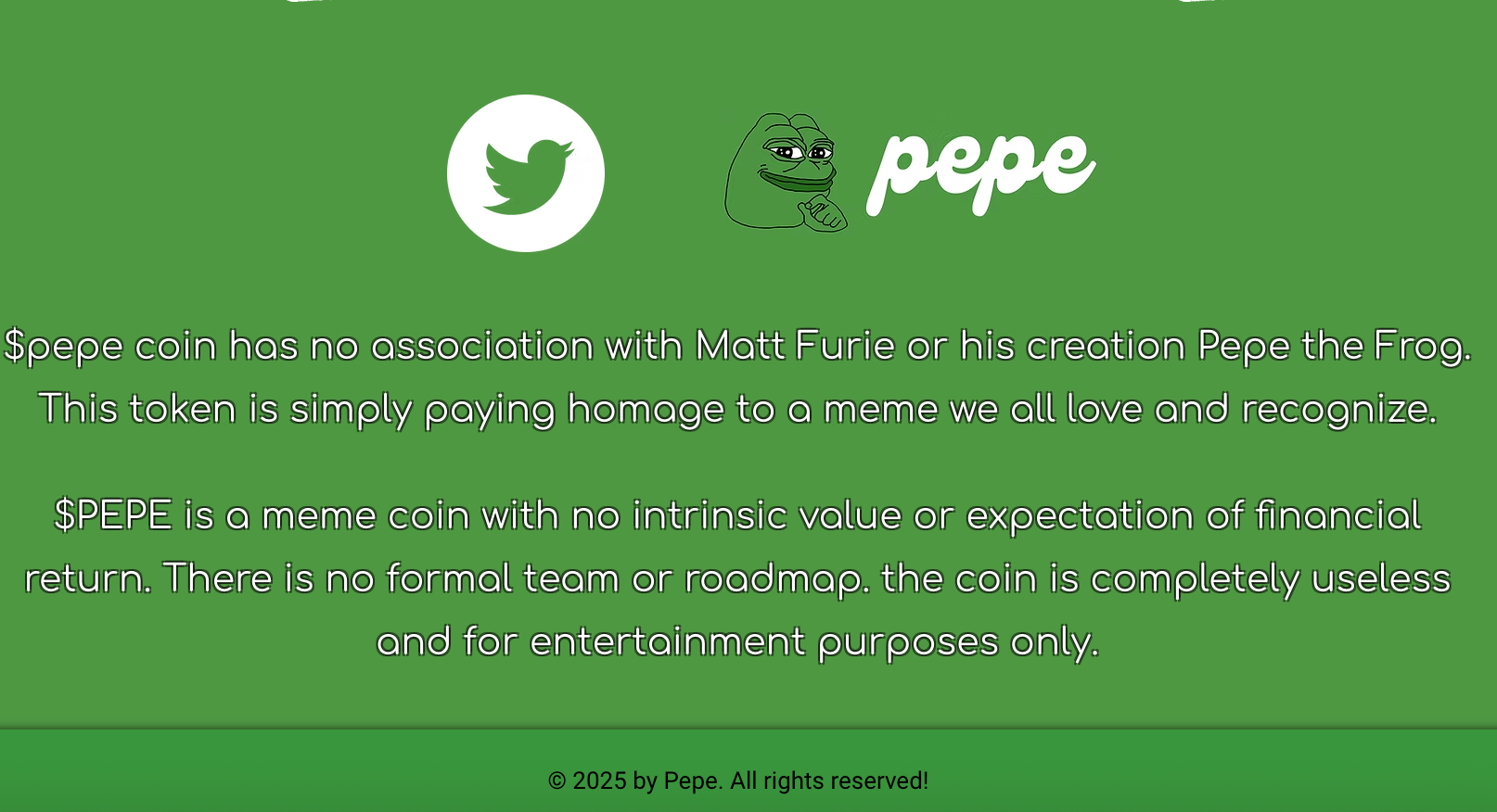
Source | PEPE has no utility by design.
- Pure supply and demand: The price moves only because people want to buy or sell it. There's no revenue, no fees flowing to holders and no company behind it.
- Community over company: The team has always been anonymous. There's no CEO, no office and no product launch to wait for.
I find that kind of refreshing. Plenty of crypto projects promise the world and deliver nothing. PEPE is quite upfront about things.
Where PEPE Came From
The frog before the coin
Pepe the Frog started life in Matt Furie's comic Boy's Club in 2005 and later became one of the most shared memes online. The coin borrowed the image, but the project's website says it has no association with Furie or his character.
Launch week in April 2023
PEPE appeared on Uniswap in mid-April 2023. It was what crypto people call a "stealth launch":
- No presale or private funding round.
- 93.1% of supply sent to a Uniswap liquidity pool, with the liquidity tokens burned.
- About 6.9% placed in a team multi-signature wallet for future exchange listings and bridges.
- Contract ownership renounced, so nobody can mint new tokens or change the rules.
The first big run
By early May 2023, PEPE's market cap had crossed $1.5 billion. The same day, it got its first major centralized exchange listing which opened it up to millions of people who would never touch a decentralized exchange.
How PEPE Works Under the Hood
Here's the setup:
A few points worth spelling out:
- The "deflation" is a one-off: The only meaningful burn was a manual one back in October 2023. Nothing in the contract burns tokens automatically.
- One wallet is blacklisted forever: Hours after launch, the team blacklisted an early buyer holding about 2.5 trillion PEPE. Since the contract was renounced afterwards, that block can never be lifted.
- Gas still applies: Moving PEPE on Ethereum costs ETH for network fees, even though the token itself has no tax.
The Rough Patches Every Buyer Should Know About
The August 2023 multisig incident
In August 2023, about 16 trillion PEPE left the team's multi-signature wallet and landed on centralised exchanges. The remaining team said three former members had cut the wallet's signing threshold from five of eight to two of eight and sold the tokens. The price fell about 20% shortly after.
The October 2023 burn
A couple of months later, the team burned 6.9 trillion PEPE worth about $5.5 million, and the price jumped roughly 31% in a day. It also announced a new team of advisors. The burn was a goodwill gesture, but it showed how much supply a small, unnamed group still controlled.

Concentrated ownership
Canary Capital's filing says the ten largest PEPE wallets held about 41% of circulating supply as of January 2026, as reported by Cointelegraph. Some of those wallets belong to exchanges holding customer funds, so it's less alarming than it sounds. Still, a few large sellers can move the market fast.
Copycat tokens
Pepe 2.0, Pepe 3.0 and dozens of lookalikes exist, with separate contracts and different rules. Always confirm you're looking at the original PEPE token before you buy or trade.
Pepe Coin Price: Where It Stands in November 2026
Here's the full arc in numbers:
- April 2023: Launch on Uniswap
- May 2023: Market cap passes $1.5 billion
- December 2024: All-time high of about $0.00002803, PEPE's best price so far
- April 8, 2026: Trading near $0.0000036 when Canary filed its ETF paperwork
- November 11, 2026: About $0.000005, market cap near $2.196 billion, ranked #42 on CoinGecko
Why the PEPE Price Swings So Hard
PEPE has no earnings or product updates to anchor it, so its price reacts almost entirely to mood and money flow. Its own history shows this clearly.
When former team members dumped tokens back in August 2023, the price fell about a fifth. When the team burned tokens two months later, it rose by nearly a third in a day. Neither event changed what PEPE is. But both affected how people felt about it.
The ETF filing in April 2026 is a good counterexample. It was arguably the biggest headline PEPE has ever had, yet the news had little impact on its price. Traders seemed to treat it as a long shot rather than a done deal.
Canary's filing warns that PEPE is highly volatile and driven largely by social media hype. Large leveraged positions add fuel in both directions, since a sharp move can trigger waves of liquidations.
My read is that PEPE amplifies whatever the crypto market is already doing. In a euphoric market it can outrun pretty much everything. When sentiment turns, it gives those gains back just as fast.
How to Trade PEPE in India
On crypto trading platforms like Delta Exchange India, PEPE trades as the 1000PEPE perpetual contract (1000PEPEUSD). The "1000" prefix means each unit tracks the price of 1,000 PEPE, which keeps the numbers readable.
A few contract details worth knowing:
- Perpetual contracts don't expire, so you can hold a position as long as your margin covers it.
- You can go long if you expect the price to rise, or short if you expect it to fall.
- Delta's 1000PEPE contract details table lists maximum leverage of 20x, with taker fees of 0.05% and maker fees of 0.02%, and you can trade PEPE on Delta Exchange.
- Deposits and withdrawals are INR only, through UPI, IMPS, NEFT or RTGS.
- You trade the contract, not the token, so there's no PEPE to store or send. This is not a spot market.
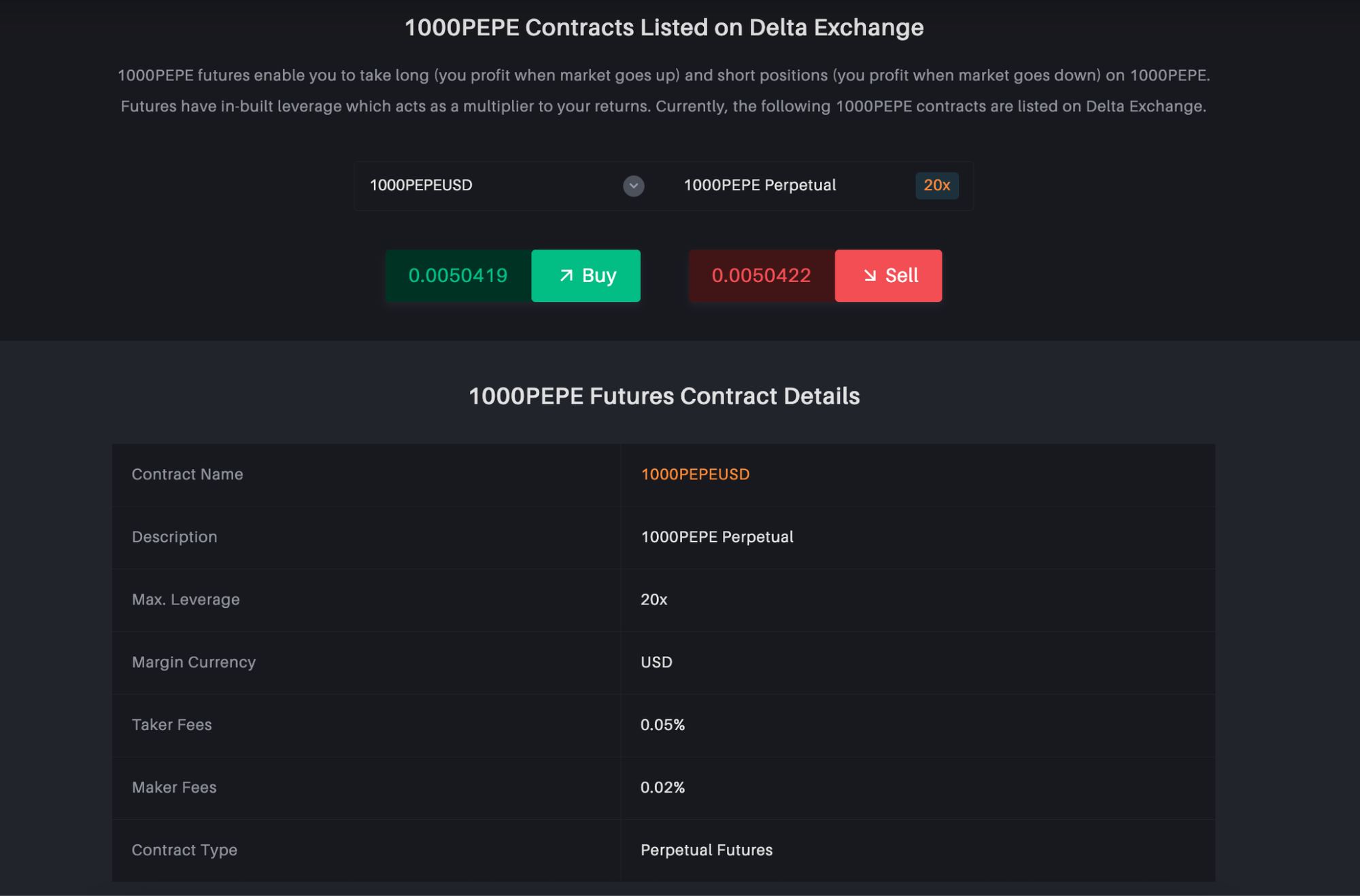
The basic flow goes like this:
- Sign up, complete KYC,
- Add rupees and
- Open the 1000PEPEUSD market.
From there, pick a position size and leverage, and set a stop-loss before you place the order.
A word of caution from my side: remember that PEPE fell about 20% after the August 2023 multisig incident and jumped back up 31% after the October burn. At high leverage, moves like that can wipe out your margin. So if you're new to futures, probably best to start with low leverage and a small amount until you understand how margin, funding and liquidation work.
Taxes in India
The tax rules are strict whichever way you trade:
- Crypto gains are taxed at a flat 30%, plus cess, as set out in the Income Tax Department's VDA guidance.
- 1% TDS applies to qualifying transfers.
- Losses can't be set off against other income.
- The new Income-tax Act, 2025, in force since April 1, 2026, kept these rules and renumbered the sections.
Is PEPE Right for You?
PEPE might make sense if:
- You enjoy crypto culture and accept you're trading a meme, not a business.
- You're putting in money you could lose completely without it hurting.
- You want small, speculative exposure alongside larger, steadier holdings.
PEPE is probably not for you if:
- You need the money within a year or two.
- You're looking for dividends, yield or any underlying value.
- Watching a position drop 50% would push you into panic selling.
- You're planning to use high leverage without having traded futures before.
I see PEPE as entertainment with a price tag. PEPE still trades thousands of percent above its all-time low, so early buyers are far ahead. Anyone who bought near the 2024 peak is down about 82%.
That’s a Wrap
PEPE is one of the purest meme coins out there. It has a fixed supply, a renounced contract, no tax and no pretense of utility. Its past includes a big early rally, an insider sell-off, a goodwill burn and a record high in late 2024, followed by a long slide. The ETF filing has given it fresh attention in 2026, but a filing isn't an approval.
If you do decide to trade PEPE, keep the amount small, use leverage carefully and remember that the price can halve without any news at all.
Frequently Asked Questions
- What is Pepe coin used for?
Answer: Pepe coin is mostly for trading and speculation. PEPE has no staking, governance or revenue attached to it. People hold it for its meme value and its price swings.
- Who created Pepe coin?
Answer: An anonymous team launched the Pepe coin in April 2023. But it is not affiliated with Matt Furie, the artist behind Pepe the Frog.
- Can PEPE reach one cent?
Answer: I think that’s unlikely. With about 420 trillion tokens, $0.01 each would mean a market cap above $4 trillion, nearly 2,000 times its size in November 2026.
- Can I trade PEPE in India without holding the token?
Answer: Yes. On Delta Exchange India, you can trade the 1000PEPEUSD perpetual contract with rupee deposits and go long or short, without storing any PEPE in a wallet.
- Has the PEPE ETF been approved?
Answer: Not yet. Canary Capital filed in April 2026 and submitted an amended filing in October 2026, but the SEC hadn't declared it effective by late October.
- Is Pepe crypto legal in India?
Answer: Yes, trading crypto isn't banned in India, but gains are taxed at 30% with 1% TDS on transfers.