What Is Bitcoin and How Does It Work? Complete Guide

All the hard facts first - Bitcoin is digital money that runs on a public network of computers, not a bank. No company owns it and no government prints it. The rules cap the supply at 21 million coins, and as of late 2026, about 20.11 million of those have been mined since the network went live in January 2009. As of mid November 2026, one BTC is worth roughly ~$64,000, according to CoinGecko.
In this post, I'll cover what is Bitcoin and how does it work, how it keeps track of who owns what, how bitcoin mining works, and the risks to know before buying.
Key Takeaways
- Bitcoin is a decentralized digital currency launched in 2009 by the pseudonymous Satoshi Nakamoto.
- Every payment goes on the blockchain, a public ledger copied across thousands of computers.
- Bitcoin mining adds a new block about every 10 minutes, and it's the only way new coins get created.
- There will only ever be 21 million BTC. The 20 millionth was mined on March 9, 2026, and the last should come around 2140.
- Miners have earned 3.125 BTC per block since the April 2024 halving. The next halving is due in 2028.
- Payments can't be undone, the price swings a lot, and in India your gains are taxed at a flat 30%.
What Is Bitcoin? A Quick Overview
Bitcoin is like money that only exists online, and you can send it to anyone without a bank in the middle.
Normally your bank keeps the record of who paid whom. Bitcoin puts that record in public, where anyone can check it.
A few things make it different from regular currency:
- There's no central bank, just thousands of independent computers (nodes) around the world.
- Nobody can print more units. The code allows 21 million BTC and that's it.
- You can buy a tiny piece, since one bitcoin splits into 100 million units - called satoshis.
- The code is open source, so anyone can read how it works.
- Payments show wallet addresses rather than names, but they stay on the public record forever.
Bitcoin has a reputation for being anonymous, but it’s actually pretty transparent, since anyone can look up any payment.
Where Did Bitcoin Come From?
Bitcoin showed up during the 2008 financial crisis, when trust in banks was at a low. On October 31, 2008, someone calling themselves Satoshi Nakamoto shared a nine-page paper called "Bitcoin: A Peer-to-Peer Electronic Cash System." It explained how to send money online without a bank.
A few early dates:
- On January 3, 2009, Satoshi mined the first block, known as the genesis block. Its data includes a line from that day's Times: "Chancellor on brink of second bailout for banks."
- On January 12, 2009, Satoshi sent programmer Hal Finney 10 BTC in the first bitcoin transaction.
- In December 2010, Satoshi made their last forum post. By April 2011, they'd emailed developers saying they'd "moved on to other things".
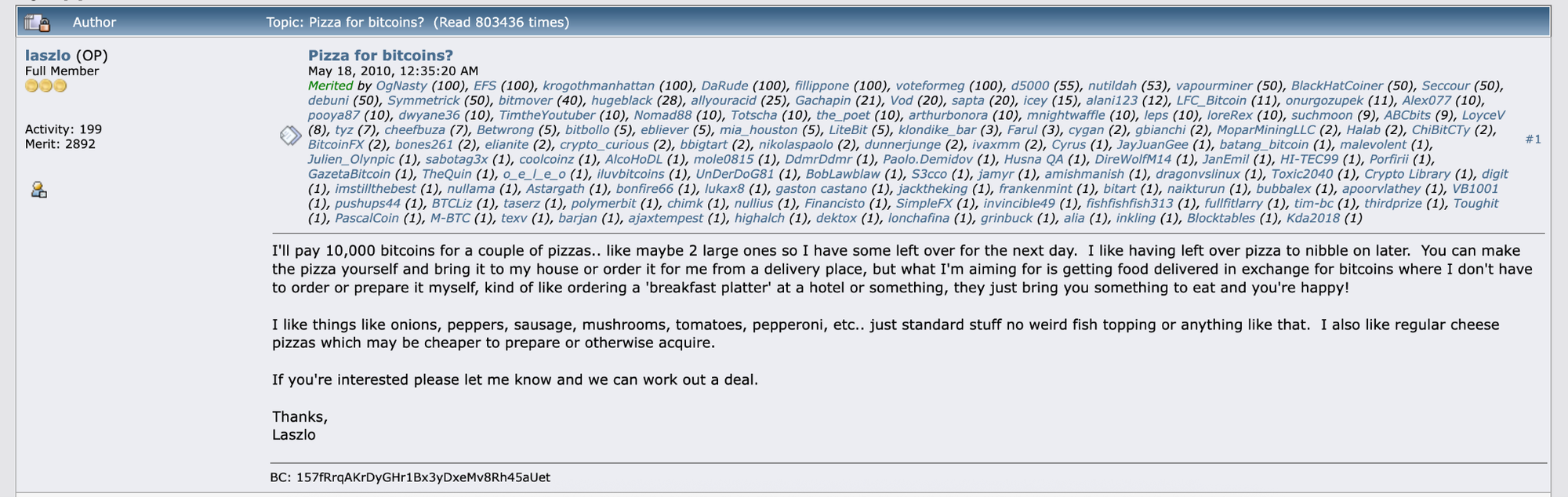
On May 22, 2010, Laszlo Hanyecz posted on BitcoinTalk that he'd traded 10,000 BTC for two pizzas. May 22 is now Bitcoin Pizza Day.
By the way, nobody knows who Satoshi is, and nobody who's claimed the name has proven it. I think that helps Bitcoin, since there's no founder anyone can pressure, manipulate or engage with in any way. It’s truly a global community.
Satoshi didn't invent every piece, either. Merkle trees and time-stamped data chains existed by the early 1990s. The new bit was combining them to stop double-spending, where someone spends the same coin twice.
How Does Bitcoin Work?
The Blockchain
The blockchain is a record of every bitcoin payment ever made. Thousands of computers each hold a full copy, and new payments get added in batches called blocks, roughly every 10 minutes.
Each block carries a digital fingerprint (a hash) of the block before it, which links them into a chain. Change an old payment and the fingerprint changes, so every other computer rejects the edit.
Wallets and Keys
A bitcoin wallet doesn't actually store coins. The coins sit on the blockchain, and your wallet stores the keys that let you spend them.
- Your public address works like an account number. You give it out so people can pay you.
- Your private key signs your payments. Whoever has it controls the coins, so never share it.
- Your seed phrase is 12 or 24 words that can restore your wallet if you lose your phone. It’s like a forgot password operation.
Hot wallets are internet-connected apps, fine for small amounts. Cold wallets, like hardware devices, keep keys offline. If losing the money would hurt, keep it in cold storage.
What Happens When You Send Bitcoin?
- Your wallet writes up the payment, saying how much BTC goes to which address.
- It signs the payment with your private key, which proves the coins are yours without showing anyone the key.
- The payment goes out to the network and waits with other unconfirmed payments.
- Nodes check the signature and make sure you haven't already spent those coins.
- A miner adds it to a new block. Once that block is on the chain, your payment has its first confirmation.
Also, Bitcoin doesn't keep a running balance like your bank app. It tracks "unspent transaction outputs" (UTXOs), which work like paper bills. Pay $3 with a $5 bill and you get $2 back, and Bitcoin handles change the same way.
What Is Bitcoin Mining?
Mining is what confirms payments and creates new coins.
Proof of Work
Miners run machines called ASICs that make trillions of guesses every second, using the SHA-256 hashing algorithm. They're looking for a number that, mixed with the block's data, produces a hash below a target the network sets. There's no shortcut. So, it’s basically guessing over and over until someone gets lucky.
Whoever finds it first shares the block. Finding the answer is hard, but checking it takes a split second, so other nodes confirm it fast. That's Proof of Work.
To rewrite past payments, an attacker would need more computing power than every other miner combined.
The network also adjusts difficulty every 2,016 blocks (about two weeks) to keep blocks coming roughly every 10 minutes.
Also read: Cryptocurrency Mining in India: Setup Cost, Legality & Risks
Rewards and the Halving
The miner who wins a block gets paid in two ways:
- New bitcoin (the block subsidy), currently 3.125 BTC per block.
- Fees from everyone whose payment made it into that block.
Every 210,000 blocks, or roughly every four years, the subsidy gets cut in half. This is the halving. It started at 50 BTC in 2009, then went to 25, 12.5, 6.25, and finally 3.125 in April 2024. The 2028 halving should drop it to 1.5625 BTC.
But hardly anyone mines alone now. Most join pools that share rewards, like Foundry USA, AntPool and F2Pool. Bitcoin mining is a serious industry, and some big miners are shifting power to AI data centres, which pay better at the moment.
The Energy Question
Bitcoin mining uses a lot of electricity, and critics are right to point that out.
Supporters say more miners now run on cheap renewable power or "stranded" energy that would otherwise go to waste, like flared gas or extra hydro. I feel like both sides quote whichever numbers suit them, and the energy mix varies a lot by country.
Bitcoin in Numbers (November 2026)
Market figures are from CoinGecko as of November 15, 2026.
What Do People Use Bitcoin For?
If you’re wondering what bitcoin is good for in everyday life, people mostly use it in these ways:
- Saving for the long term, because nobody can inflate the supply. Bitcoin is one of the best performing assets in human history.
- Sending money abroad without waiting days for a bank transfer.
- Paying for things, with Bitcoin’s Lightning Network making small payments quicker and cheaper.
- Trading price moves, often with futures and options.
- Institutional holding. Spot Bitcoin ETFs own a lot of BTC, and Strategy, the largest corporate holder, reported 850,364 BTC as of November 9, 2026.
Also read: What is a Bitcoin ETF? Guide to Spot & Futures Bitcoin ETFs
Risks to Know Before You Buy
- The price moves fast. In other words - it can be quite volatile. Bitcoin fell about 15.5% in the week to November 15, 2026, and at around $64,700 it's nearly ~50% below its October 2025 peak.
- If you lose your seed phrase, you lose your coins. There's practically no reset button. There’s no bank to go to, remember?
- Scams are everywhere, from fake apps to "guaranteed return" schemes to people pretending to be support staff.
- Payments are final, so a wrong address means lost money.
- Coins you leave on an exchange are only as safe as that exchange.
It’s best to turn on two-factor authentication, move bigger amounts to a hardware wallet, and never share your seed phrase. Support teams that are legit won't ask for it.
Bitcoin in India: Taxes and Access
In India, crypto counts as a Virtual Digital Asset (VDA). Gains are taxed at a flat 30% plus surcharge and cess, you can't set losses off against other income, and 1% TDS is deducted on transfers above a threshold under Section 194S. The Union Budget 2026-27 left all of this unchanged.
To buy bitcoin in India, stick to exchanges registered with the Financial Intelligence Unit (FIU-IND). Crypto trading platforms like Delta Exchange India, offer both spot and derivatives in one account. You can buy bitcoin with rupees or trade Bitcoin futures and options that settle in INR seamlessly.
That’s a Wrap
I see Bitcoin as a money experiment that has kept running for almost 18 years without a CEO or a head office. It's clever and it's proven pretty tough, but it's also very volatile, and it doesn't forgive mistakes.
If you’re considering buying Bitcoin, I’d suggest taking it slow. Start small, learn how keys work first, and only put in what you could watch fall by half without losing sleep.
Frequently Asked Questions
- What is bitcoin?
Answer: Bitcoin is digital money you can send straight to someone over the internet, with a public network of computers keeping the record instead of a bank.
- How does bitcoin work without a bank?
Answer: Thousands of nodes keep copies of the blockchain and check every payment against the same rules. Miners compete to add new blocks, and the network only accepts the valid ones.
- Is bitcoin mining profitable in 2026?
Answer: That depends on electricity costs and how efficient your machines are. With the reward at 3.125 BTC and prices down this year, margins are thin. For most people in India, mining at home doesn't make sense.
- Can the 21 million limit ever change?
Answer: Technically the code could change, but it would need most users, node operators and miners to agree. That's very unlikely, since the cap is a big part of why people value Bitcoin.
- Is bitcoin legal in India?
Answer: Yes. Owning and trading it is allowed. It's taxed as a VDA, and exchanges have to register with FIU-IND. It isn't legal tender, though, so shops don't have to accept it.
- What is bitcoin halving?
Answer: It's when the mining reward gets cut in half, which happens every 210,000 blocks. The last one was in April 2024, and the next is expected in 2028.
- Can I buy bitcoin on Delta Exchange India?
Answer: Yes. Delta Exchange India is registered with FIU-IND and lets you buy spot bitcoin with rupees through the BTC-INR pair. The same account also gives you Bitcoin futures and options, with everything settled in INR.