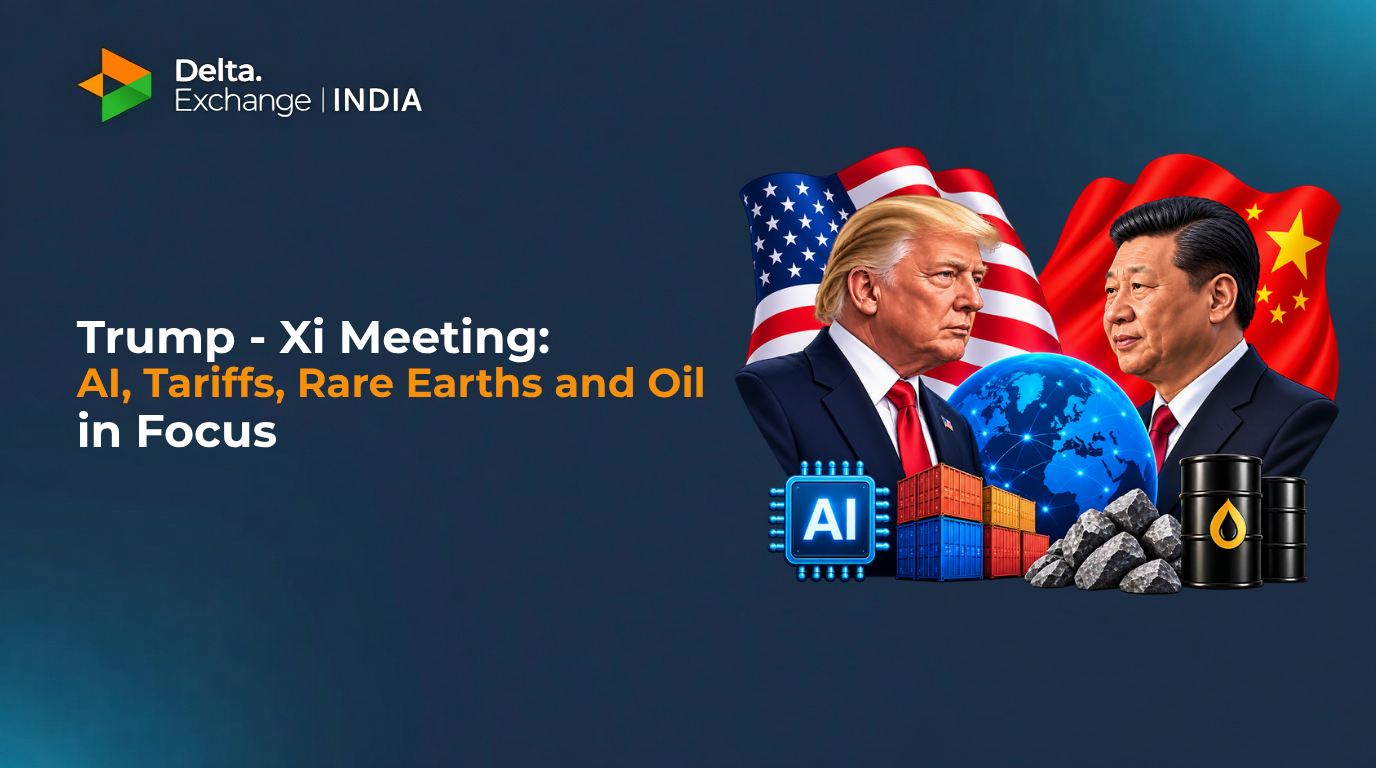
Trump–Xi Meeting: AI, Tariffs, Rare Earths and Oil in Focus

On September 24, President Trump and President Xi Jinping will meet in Washington. Markets are watching because the meeting comes at a time when the US and China are dealing with several major issues — tariffs, AI and semiconductors, rare earths and the Iran conflict.
This is unlikely to solve all of these issues. The bigger question is whether both sides can keep tensions under control and avoid another round of escalation.
Tariffs: The Biggest Market Issue
Trade will be one of the main topics.
The current US-China tariff truce is due to expire on November 10, making an extension an important part of the discussions. Both sides are also looking at possible tariff reductions on some non-strategic goods.
For markets, lower tariffs would reduce some pressure on supply chains and inflation.
For crypto, lower trade tensions could improve overall risk appetite and support BTC.
For tech stocks, lower tariffs could reduce uncertainty for companies with large global supply chains.
If talks instead lead to renewed escalation, markets could start pricing higher tariffs, inflation and tighter financial conditions.
AI and Tech Stocks
AI has become one of the biggest areas of competition between the US and China.
The US continues to restrict China's access to advanced AI technology, while China wants fewer restrictions on its technology sector. AI and semiconductor issues are expected to be part of the broader discussions around the summit.
The key question for tech stocks is whether the two sides can prevent the technology conflict from getting worse.
Any progress on AI dialogue or greater clarity around technology restrictions could reduce uncertainty for semiconductor and AI companies. But there is no indication of a major agreement on chip export controls yet.
Taiwan: Why It Matters
Taiwan matters not only because of US-China tensions, but also because it sits at the center of the global semiconductor supply chain.
TSMC produces many of the advanced chips used in AI and high-performance computing. Taiwan is also continuing to expand its advanced semiconductor capacity, highlighting its importance to the global technology industry.
Any escalation around Taiwan could raise concerns about chip supplies, shipping and global supply chains, putting pressure on tech stocks and broader risk assets.
For the Trump-Xi meeting, markets will therefore watch the language around Taiwan closely.
Rare Earths: Another Key Risk for Tech
Rare earths are another important issue.
China plays a major role in the processing and supply of rare-earth materials used across electronics, semiconductors, EVs and other high-tech industries. Both sides are trying to keep the issue from becoming another source of escalation.
If supplies remain stable, it removes one risk for technology companies.
If export restrictions tighten again, supply-chain concerns could return quickly and put pressure on parts of the tech sector.
Iran and Oil
Iran is an important issue for the oil market because China is a major buyer of Iranian crude and maintains strong economic ties with Tehran.
This gives China some potential influence, but there is no clear indication that Xi will broker a US-Iran deal at the summit. The more realistic market question is whether US-China discussions can prevent the Iran issue from becoming another source of escalation.
Oil remains highly sensitive to developments around the Strait of Hormuz, where disruptions have already affected global energy flows.
Any sign of lower tensions could reduce some of the geopolitical premium in oil. A worsening conflict could have the opposite effect.
What It Means for Markets
For tech stocks, watch AI chips, export controls, Taiwan and rare-earth supplies.
For oil, the focus is Iran, Chinese crude purchases and the Strait of Hormuz.
For crypto, the main channel is risk appetite. Lower tariffs and less geopolitical tension could support BTC, while a breakdown in talks could increase risk-off pressure.
The meeting does not need to produce a major deal to matter.
For markets, simply avoiding another round of escalation could be significant.