Collar Option Strategy: How to Hedge Crypto Without Selling

A collar option strategy protects an existing crypto holding by buying an out-of-the-money put (sets a price floor) and selling an out-of-the-money call (sets a price ceiling), using the call premium to offset the put's cost. It caps both losses and gains, making it a low-cost way to hedge BTC or ETH through volatile periods without selling the position.
The world of crypto trading can be a rollercoaster ride with extreme volatility and unpredictable price movements. As a result, traders are always looking for ways to protect their investments and manage risks effectively. This is where the collar options strategy comes in. If you're looking to protect your investments and manage risks in the volatile world of crypto options trading, the collar strategy might be just what you need.
In this article, we will introduce you to the collar options strategy and how it can be used to limit losses and protect profits in crypto trading. Let's get started with the basics - what is the collar options strategy?
What is a Collar Options Strategy?
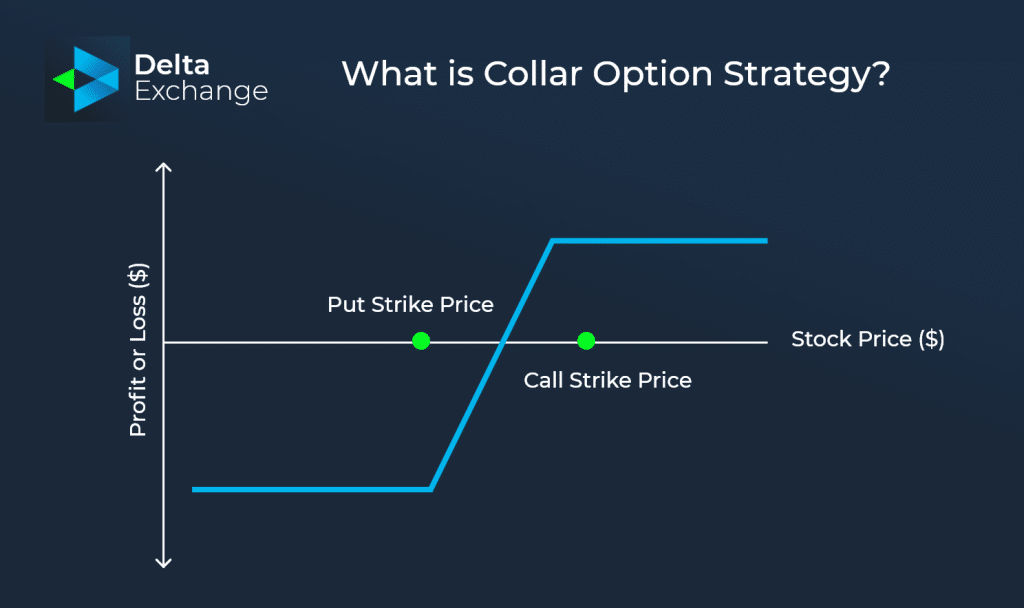
A collar options strategy is a hedging technique that combines two positions on an asset you already own: buying a protective put and selling a covered call at the same time, usually with the same expiry date.
Put option (bought): gives you the right to sell the underlying at the strike price if the market falls below it - this is your downside floor.
Call option (sold): obligates you to sell the underlying at the strike price if the market rises above it - this caps your upside and pays you a premium that offsets the put's cost.
Because the strategy layers a protective put on top of an existing (or simultaneously acquired) holding, it's sometimes called a "protective collar" or "hedge wrapper." It's most commonly used by long-term BTC/ETH holders who want to stay invested through a volatile stretch without full exposure to a crash.
How Does a Collar Strategy Work?
The gap between the put strike and the call strike is the "collar" - the price range within which your position moves freely. Outside that range, the options take over and lock in either the floor or the ceiling.
Collar Strategy vs. Other Hedging Strategies
Step-by-Step: How to Set Up a Collar Options Strategy
In the context of crypto options trading, the collar strategy can be used to protect against price fluctuations and mitigate risks. Here are the steps to use the collar options strategy in crypto trading:
- Identify the underlying asset: Select the cryptocurrency that you want to trade and choose a strike price.
- Purchase a put option: Buy a put option with a strike price below the current market price of the cryptocurrency. This will allow you to sell the asset at the strike price if the market price falls.
- Sell a call option: Sell a call option with a strike price above the current market price of the cryptocurrency. This will obligate you to sell the asset at the strike price if the market price rises.
- Set the expiration date: Determine the time frame for the options contract to expire. Typically, traders select a timeframe between one to six months, depending on their investment goals.
- Monitor the market: Keep an eye on the market price of the cryptocurrency and the strike prices of the options contracts.
- Adjust the strategy: Depending on the market conditions, you may need to adjust the collar options strategy. For example, if the market price of the cryptocurrency rises significantly, you may want to buy back the call option to limit your potential losses.
Using the collar options strategy in crypto options trading can help you protect your investments and manage risks. However, it is important to understand the risks associated with crypto options trading and to have a solid understanding of the market conditions before implementing this strategy. It is always recommended to consult with a professional financial advisor before making any investment decisions.
Risks and Limitations of the Collar Strategy
- Capped upside: if the market rallies past your call strike, gains beyond that level are given up.
- Opportunity cost in strong bull runs: a collar underperforms simply holding the asset during a sustained rally.
- Assignment risk: on American-style options, the sold call can be assigned before expiry. (Delta Exchange's crypto options are European-style, so early assignment isn't a concern.)
- Liquidity and slippage: wide bid-ask spreads on less-liquid strikes can make entering or adjusting a collar more expensive than modeled.
- Net premium and fees: even a "zero-cost" collar can carry a small net debit plus exchange fees.
How to Manage Risk in a Collar Strategy
Managing risks is an essential aspect of trading, and the collar options strategy is no exception. While the collar options strategy can help limit potential losses and protect profits, it is important to understand the risks involved and take steps to manage them effectively. Here are some tips for managing risks in the collar strategy for crypto options trading:
- Set Stop-Loss Orders: It is important to set stop-loss orders to minimize potential losses. A stop-loss order is an order that automatically sells the underlying asset if it falls below a certain price level. This can help prevent losses from escalating beyond a predetermined threshold.
- Keep an Eye on Market Conditions: Monitoring market conditions is critical when using the collar options strategy. Keep an eye on the underlying asset's price movements and the strike prices of the put and call options. Adjust the strategy accordingly based on market conditions.
- Diversify Your Portfolio: Diversifying your portfolio can help minimize risks associated with the collar options strategy. This involves investing in multiple assets across different sectors, which can help offset losses in one asset with gains in another.
- Understand the Potential Risks: Before implementing the collar options strategy, it is important to understand the potential risks associated with options trading. This includes the risk of market volatility, liquidity risk, and counterparty risk.
How to Trade a Collar Strategy on Delta Exchange
Delta Exchange's strategy builder lets you place the put purchase and call sale as a single combined order, so both legs execute together rather than leaving you exposed between fills. You can select matching expiries directly in the builder and see the net premium before confirming the trade.
Final Words
Here’s a hypothetical to sum up what we’ve learned today Assume you have 10 BTC in your portfolio and are concerned about potential downside risk. You decide to implement the collar options strategy to protect your investment.
Step 1: Buy a Put Option
You buy a put option with a strike price of $55,000 that expires in three months. This gives you the right to sell your BTC at $55,000 if the market price falls below that level.
Step 2: Sell a Call Option
You sell a call option with a strike price of $60,000 that expires in three months. This gives someone else the right to buy your BTC at $60,000 if the market price rises above that level.
Step 3: Manage the Collar
The difference between the strike price of the put option and the call option is known as the "collar." In this case, the collar is $5,000 ($60,000 - $55,000). This is the range within which you can buy or sell your BTC. If the market price of BTC falls below $55,000, you can exercise your put option and sell your BTC at that price. If the market price rises above $60,000, the buyer of the call option can exercise their option and buy your BTC at that price.
Step 4: Manage Risks
To manage risks effectively, you can set a stop-loss order to sell your BTC if the market price falls below a certain level, such as $50,000. This can help limit potential losses. In summary, the collar options strategy can be used to protect your BTC investments against downside risk while also providing a source of income through the sale of call options. By setting a collar and managing risks effectively, you can protect your investments and minimize potential losses in the volatile world of crypto options trading. Looking to get started with crypto options in India? Head over to our homepage today to find out how!
FAQs
Q1: What is a collar options strategy?
Think of a collar as a safety net with a ceiling. You hold an asset, buy a put to limit losses, and sell a call to fund it - locking yourself into a defined profit-and-loss range.
Q2: How does a collar strategy work in crypto trading?
Say BTC is at ₹70L. You buy a put at ₹65L and sell a call at ₹75L. Below ₹65L, your put saves you. Above ₹75L, your gains stop. You’re protected but range-bound.
Q3: Why is the collar strategy used in volatile markets?
When crypto swings wildly, the collar lets HODLers sleep at night - without selling. High volatility actually helps, since the sold call earns more premium, often making the entire hedge free.
Q4: What are the steps to implement a collar options strategy?
Hold BTC or ETH. Buy an OTM put at your loss limit. Sell an OTM call at your profit cap. Match expiry dates on both legs. On Delta Exchange, the strategy builder handles this simultaneously.
Q5: What are the risks of using a collar strategy?
The big trade-off is capped upside - a BTC rally beyond your call strike means missed profits. Any net premium paid also slightly reduces returns. On Delta Exchange, early assignment isn’t a concern since options are European-style.
Q6: How can traders manage risk in a collar strategy?
Pick strikes based on real price targets, not guesses. Choose expiry around your uncertainty window. Roll the collar forward if you need extended protection. Never set the call strike too close - you’ll unnecessarily choke your upside.
Q7: What is an example of a collar option strategy?
You hold 1 BTC at ₹70L. Buy a ₹65L put for ₹1.5L, sell a ₹78L call for ₹1.4L - net cost ₹10,000. A crash is cushioned; a rally is capped. Cheap protection, defined outcome.