Crypto Options Chain Analysis: How to Read Options Chain Data

A crypto options chain is a real-time table listing every available call and put option for a crypto asset, organized by strike price and expiration date. It shows bid/ask prices, open interest, implied volatility, and mark price, so traders can read market sentiment, spot potential support and resistance zones, and build options trading strategies before placing a trade.
The world of crypto options trading is complex and dynamic. It involves a myriad of strategies and tools explored constantly by traders. Among these tools and strategies, the crypto options chain stands out as a valuable source of information for traders.
With its help, traders can make better trading decisions, implement all sorts of strategies, and manage their risk effectively. In other words - it is crucial to master the skill of crypto option chain data analysis to make the most of your trades. But before venturing into option chain analysis, let’s see a brief explanation of what a crypto options chain is and how to read options chain data step by step.
What is a Crypto Options Chain?
Crypto options are contracts that grant the holder the right, but not the obligation, to buy or sell the underlying crypto at a specified price on or before a specified date. As traders would know, they are categorized into call options and put options.
A crypto options chain is a table that lists all the available options contracts - both call and put options, for a given underlying crypto asset. It typically includes information such as the bid price, bid quantity, ask price, ask quantity, and expiration date for the contracts that are listed on the chain.
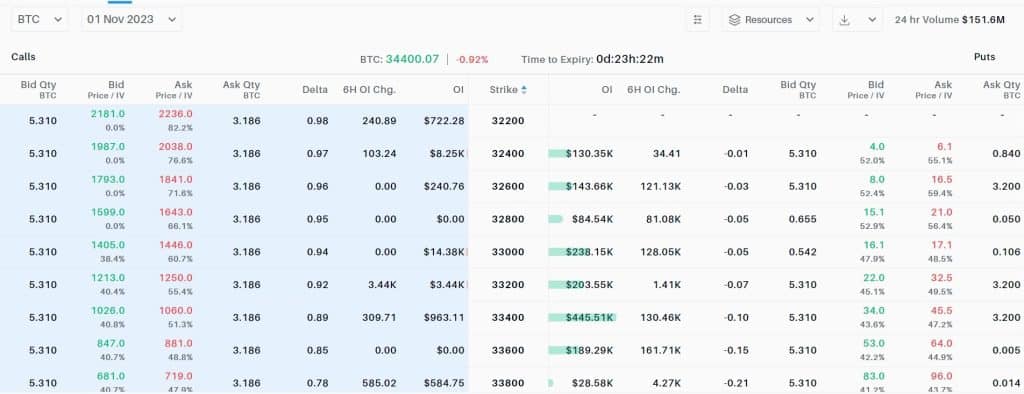
Crypto option chain analysis is the process of analyzing the data associated with crypto options contracts to identify potential crypto trading opportunities. Reading an options chain data helps assess market sentiment, identify support and resistance levels, and gauge the volatility of the underlying crypto.
How to Read a Crypto Options Chain: 5 Steps
A crypto options chain may initially seem like rows of random numbers that make no sense. A closer look reveals that it provides valuable information that can be leveraged for making crypto options trading decisions. Here's a simple process to read one:
- Pick the expiry date. Every options chain is organized by expiration date first - start by selecting the expiry you want to trade.
- Scan strike prices around the current spot price. Strikes near the money usually have the tightest spreads and highest liquidity.
- Compare bid and ask prices. A tight bid-ask spread signals an actively traded, liquid contract.
- Check open interest and volume. High open interest at a strike shows where traders are positioned and can flag potential support or resistance.
- Review implied volatility and mark price. These tell you how the market is pricing risk and what value is used for unrealized PnL and liquidation.
Key Elements of Crypto Options Chain Data
Call option: A call option is a contract that grants the buyer the right, but not the obligation, to buy the underlying crypto at a predetermined price within a specified expiration date.
Put option: A put option is a contract that grants the buyer the right, but not the obligation, to sell the underlying crypto at a predetermined price within a specified expiration date.
Bid prices: Bid prices refer to the highest price crypto traders will be willing to pay for crypto.
Ask prices: Ask prices refer to the lowest price crypto traders will accept for selling their crypto.
Bid quantity: Bid Quantity refers to the number of buy orders booked for a particular strike price. It tells the current demand for the strike price of an option.
Ask quantity: Ask quantity refers to the number of open sell orders for a particular strike price. It indicates the availability of the options.
Expiration date: The expiration date is the last day the options contract can be exercised. After that day, the contract becomes invalid and cannot be settled.
Strike price/exercise price: The ‘strike price’ of an options contract is the value at which both buyers and sellers of the option agree to exercise a call or put option. It is the price at which the underlying crypto is bought or sold if the option is exercised.
Implied Volatility (IV): Implied volatility reflects price swings in an asset. High implied volatility refers to significant price swings, and low implied volatility refers to stable prices.
Open interest (OI): Open interest represents the interest of traders in the crypto options for a specific strike price. The greater the open interest, the more traders are interested in that option for that particular strike price and expiration date.
Change in Open interest: Change in Open interest is the difference between the current day’s open interest and the prior trading session’s open interest. When open interest increases, new money enters the market for that option. Conversely, when open interest decreases, it usually indicates that the market is liquidating and fewer investors participate.
Options volume: Options volume refers to the total number of contracts traded by traders at a specific price within the market. It provides insights into current trader interests and market activity.
Last price: The last price displayed on a crypto options chain represents the price of the most recent trade that took place immediately before the contract’s expiration time.
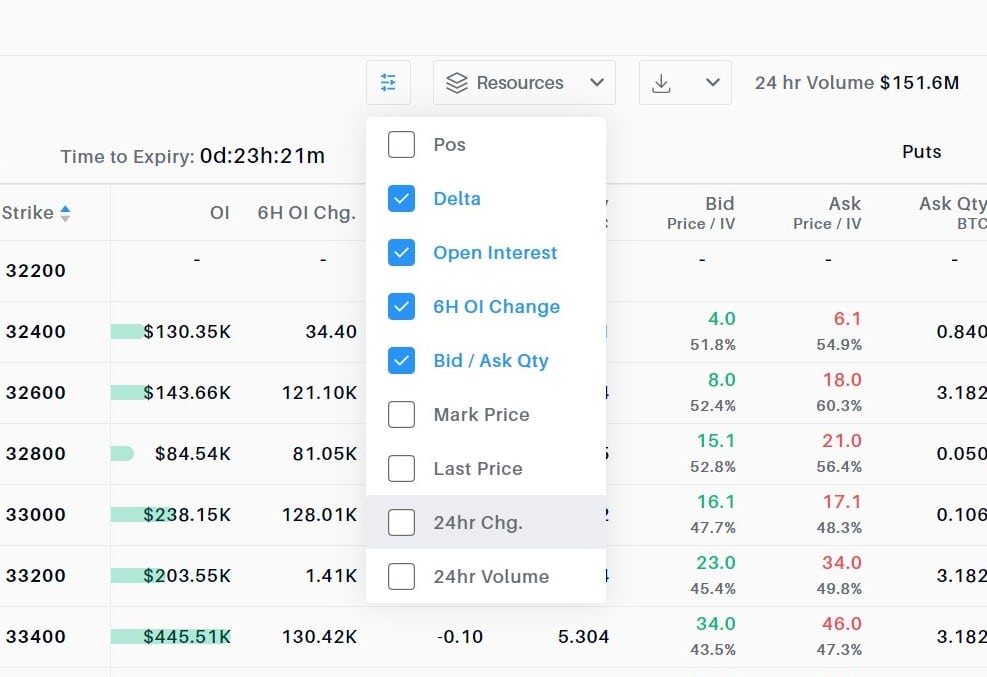
Mark Price: Mark Price is the price at which any open position is marked for the computation of Unrealized PnL and Liquidation. Mark Price is employed to prevent unwarranted liquidations due to the high volatility of crypto-assets.
In-the-Money vs. Out-of-the-Money Options
Every strike on a crypto options chain is either in-the-money (ITM) or out-of-the-money (OTM) relative to the current spot price:
Read More: Deep OTM/ITM Options
Identifying Support and Resistance Zones in Crypto Options Chain Data
To identify resistant and support zones using open interest while reading an options chain:
- Look for strike prices where the call open interest is higher than usual. These are areas where there is a lot of selling pressure, and the price is likely to face resistance.
- Look for strike prices where the put open interest is higher than usual. These are areas where there is a lot of buying pressure, and the price is likely to find support.
Once you have identified resistance and support zones through option chain data analysis, you can use this information to make informed crypto options trading decisions.
Delta Exchange Options Chain: Tools to Aid Your Analysis
Trading crypto options on Delta is easy for beginners and experts alike. Here is a walkthrough on crypto options trading on Delta. If you want to make effective crypto options trading decisions, then the Delta exchange option chain can guide you. It’s designed to provide relevant information to aid your decision-making process.
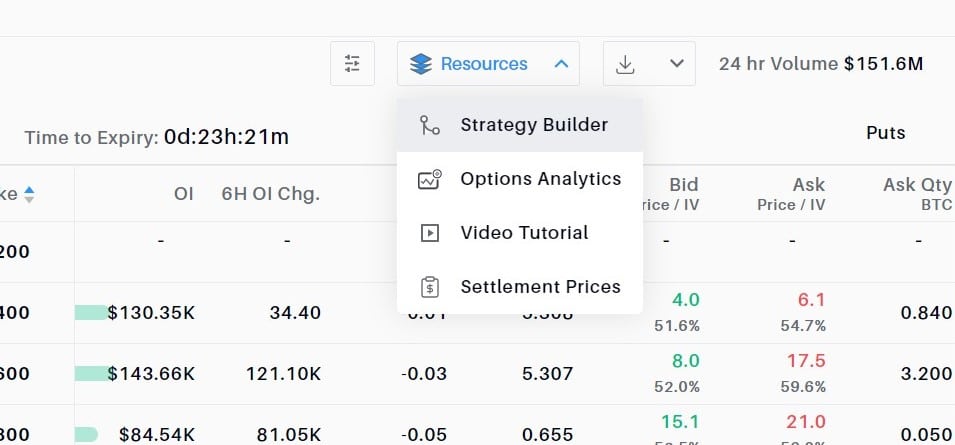
Moreover, Delta offers a crypto options strategy builder to aid your option chain analysis and enhance your crypto options trading strategies. Learn how to use Delta’s strategy builder and ace your trading.
Delta Exchange’s options analytics tool is another gem for option chain data analysis. It offers a variety of option analytics tools to help make informed trading decisions. These tools include open interest by expiration, open interest by strike, put/call volume, and implied volatility. Traders can use these tools to identify areas of support and resistance, identify potential trading opportunities, and backtest crypto options trading strategies.
Start Reading Crypto Options Chain Data With Confidence
Knowing how to read crypto options chain data is an integral skill. It can help you make informed investment decisions and come out on the winning side more often. By learning how to read the Delta Exchange option chain, Delta users can significantly improve their trading skills and overall performance in the crypto market. The valuable insights from the crypto options chain can keep you ahead in the constantly changing crypto landscape.
Frequently Asked Questions (FAQs)
Q1: What is a crypto options chain?
Answer: A crypto options chain is a real-time table listing all available calls and puts for an asset, organized by strike price and expiry. Delta Exchange displays bid/ask prices, implied volatility, open interest, and mark price in its options chain, giving traders a clear view of market positioning.
Q2: How do bid prices and ask prices differ in a crypto options chain?
Answer: The bid is the highest price a buyer will pay; the ask is the lowest a seller will accept. The gap between them reflects liquidity. Tight spreads mean an active, efficient market. Wide spreads point to lower liquidity or elevated uncertainty around that particular strike or expiry.
Q3: What does implied volatility (IV) indicate in crypto trading?
Answer: IV reflects what the market expects future price movement to look like, derived from live option premiums. High IV means expensive options, usually around major risk events. Comparing it to historical volatility helps you judge whether a contract is overpriced or relatively cheap before entering a trade.
Q4: How can open interest identify support and resistance zones?
Answer: High open interest at a specific strike signals heavy positioning at that level. Large call OI tends to act as overhead resistance; large put OI can create a floor below the spot. Near expiry, prices often drift toward max pain, the strike where total option buyer losses are highest.
Q5: What is the difference between in-the-money and out-of-the-money options?
Answer: An ITM call has a strike below current spot and carries intrinsic value, making it pricier. An OTM call sits above spot and is priced purely on time value. It is cheaper and more leveraged, but needs a larger price move to hold any value at expiry.
Q6: How does change in open interest signal market activity?
Answer: Rising open interest alongside rising prices typically means new long positions are being opened, confirming trend strength. Rising OI with falling prices points to fresh short positioning. Falling OI usually signals unwinding, which often precedes a reversal as larger participants start closing rather than building exposure.
Q7: Why is Mark Price important for managing open positions?
Answer: Mark price is Delta Exchange's fair-value estimate, calculated from spot price and funding adjustments. It determines unrealized PnL and triggers liquidations, protecting traders against sudden price spikes or thin order book conditions that could otherwise cause unjust forced exits on open positions.
Q8: How is a crypto options chain different from a stock options chain?
Answer: The core structure is the same - strikes, expiries, bid/ask, OI, and IV all work identically. The main differences are that crypto options trade 24/7 with no market close, expiries are often shorter and more frequent, and implied volatility tends to run higher due to crypto's larger price swings.
Q9: What is the best way for beginners to practice reading an options chain?
Answer: Start with a single expiry and a handful of strikes near the current spot price. Track how bid/ask, open interest, and IV shift over a few sessions before placing a trade, and use Delta Exchange's options analytics tools to cross-check what the chain is showing.