Gold Options Explained: Types, Contract Specs, and How to Trade Them in 2026

Gold is an asset people have trusted for a long time. But trading it doesn't have to mean buying a bar. Gold options let you take a view on where gold is headed at a cost you know upfront, and you never have to store a single gram.
Crypto trading platforms like Delta Exchange India offer gold options on tokenized gold, alongside perpetual contracts on PAX Gold (PAXG) and Tether Gold (XAUT). These are RWA derivatives - contracts that follow the price of a real-world asset.
In this post, I’ll explain how gold options work, which contracts are available, what to check in their details, and how to trade them on Delta Exchange India, along with the risks to understand first.
Key Takeaways
- Gold options give you the right, not the obligation, to buy or sell at a set price by a set date. You pay a premium to get that right.
- On Delta Exchange India, gold options are available on XAUT. PAXG and XAUT also trade as perpetual contracts, and tokenized silver is available as futures only, with no silver options.
- Tokenized gold is an RWA token, a digital representation of a traditional asset, issued on a blockchain. You trade the price of the token through RWA derivatives. The gold never becomes yours.
- Margin, profit and loss, and withdrawals are handled in INR.
- Buying gold options caps your loss at the premium. Selling them doesn’t, and the perpetuals carry leverage, funding and liquidation risk.
What are Gold Options?
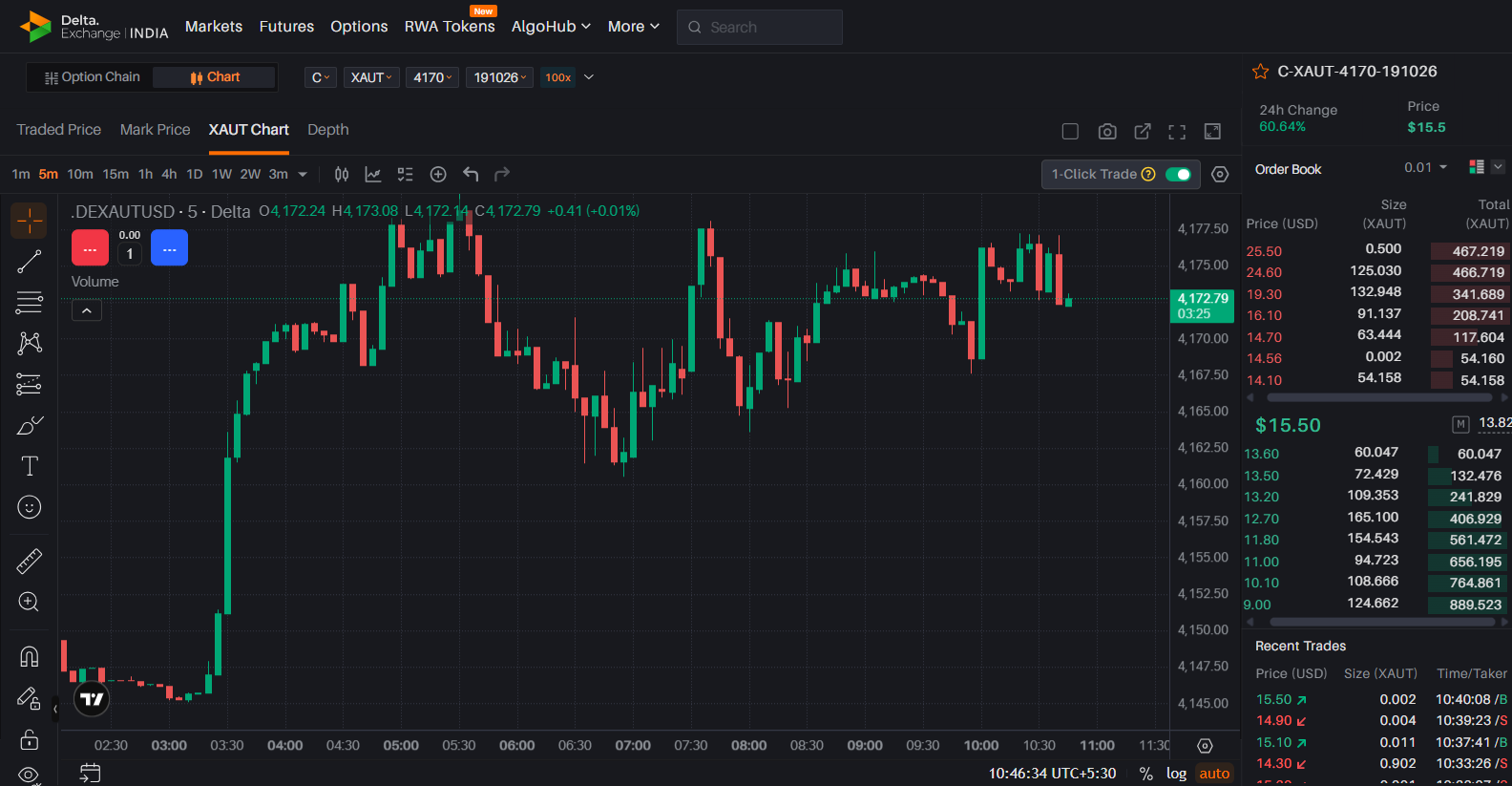
Trade XAUT Gold Token Options Chain on Delta Exchange India.
Gold options are RWA derivatives built on tokenized gold, an RWA token that follows the price of real gold. On Delta Exchange India, you trade a contract on that price, not the metal itself. You won’t receive gold, dividends or any ownership claim, and there’s no physical delivery unless a contract specifically allows for it.
With gold options, you pay a small amount upfront, the premium, for the right to buy or sell at a price agreed today. If gold doesn’t move your way, you simply don’t use that right, and the only thing lost is the premium.
Types of Gold Options
Gold options come in typically two types:
- Call option: The right to buy at the strike price. A call suits a rise in gold.
- Put option: The right to sell at the strike price. A put suits a fall in gold, and it can also protect gold exposure you already have.
Three terms decide how gold options behave:
- Strike price: The price locked in when the contract is created.
- Premium: What you pay to get in. For a buyer, this is the full risk.
- Expiry: The deadline. Every day gold doesn’t move your way, the option quietly loses value. That's time decay, and it speeds up near expiry.
Tokenized Gold Contracts Available on Delta Exchange India
Fees on Delta Exchange India are charged on the notional value of your position, not just the margin you put up. Gold and silver contracts tend to carry lower trading fees than regular futures.
Gold Options vs. Perpetuals: Choosing the Right Contract
Both let you trade the price of tokenized gold, but they carry different trade-offs:
- Gold options come with a known cost. You pay the premium upfront, and as a buyer that’s the most you can lose. The trade-off is time decay, so you can be right on direction and still lose if the move comes too late.
- Perpetuals are traded on margin with leverage. The trade-offs are funding payments between long and short positions, and a liquidation risk if the price moves against you.
If you want a defined cost for your view, gold options may suit you better. If you want to trade the price of tokenized gold directly with leverage, perpetuals may suit you better.
What to Check in the Gold Options Contract Details
Read the contract page before you put any money in. Start with the underlying, which is the RWA token the option follows, such as XAUT. Then check whether you’re buying a call or a put, since a call suits a rise in gold and a put suits a fall.
The options chain lays strikes and expiries out in one table, so you can compare gold options in a single view. Contract size is easy to skip, but it tells you how much one contract covers, and that sets your real exposure. Last, look at fees and leverage.
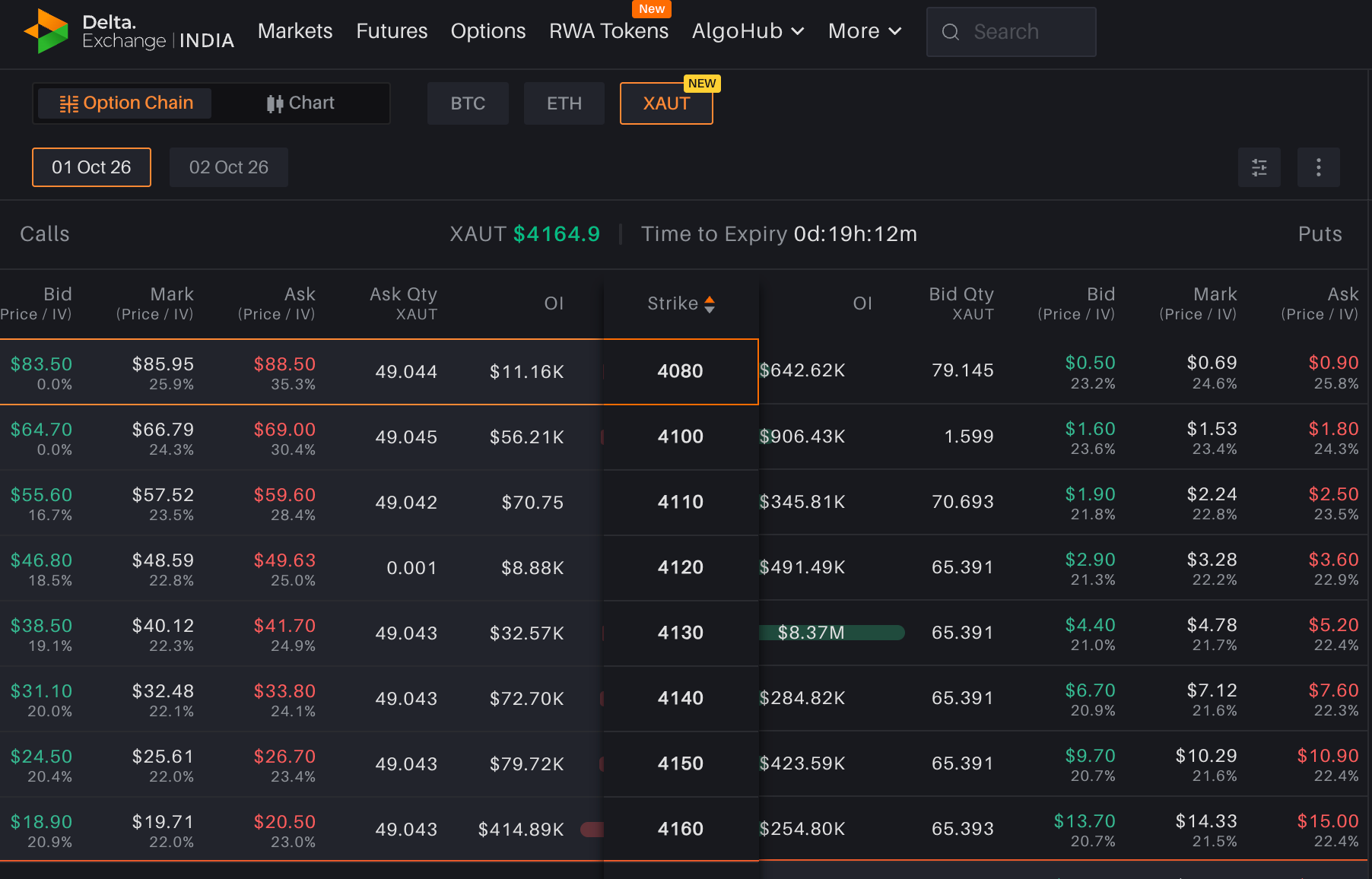
The options chain lets you browse the listed strikes and expiries for gold options.
Fees are charged on the full position value, not just your margin, and leverage stretches gains and losses alike.
How to Trade Gold Options on Delta Exchange India
Here’s a quick walkthrough:
- Put INR in your account first. Margin, profit and loss, and withdrawals all run in INR.
- Open the RWA Tokens tab and find the gold options, where the strikes and expiries are listed.
- Decide between a call and a put, depending on whether you expect gold to rise or fall.
- Pick a strike and an expiry, then look at the premium. That’s what the trade costs you.
- Keep an eye on the position. Many traders close before expiry instead of exercising.
Risks of Trading Gold Options and Other RWA Derivatives
- You can call the direction right and still lose money if gold takes too long to get there. That’s time decay at work.
- Buying a gold option caps your loss at the premium, yet the whole premium can still go. Capped doesn’t mean small.
- The risk isn’t capped in selling gold options, so it’s not exactly a starting point for beginners.
- Perpetual contracts pass funding payments between long and short positions every few hours. The aim is to keep the contract price near the actual gold price.
- When prices swing hard and fast, the platform’s insurance fund may fall short of covering losses, and profitable positions can be auto-deleveraged.
- Higher leverage means a smaller price move can get you liquidated.
I’d suggest sizing your position based on what you're comfortable losing, rather than the maximum leverage available.
A Starting Point for Gold Options
If you’re just getting into RWA derivatives, don’t rush straight to leverage, and watch how gold prices behave. Starting small and slowly increasing your position size as you get comfortable is safer than jumping in with a large trade.
That’s a Wrap
Delta Exchange India gives you ways to trade tokenized gold: gold options on XAUT, perpetual contracts on PAXG and XAUT, and futures on tokenized silver. But none of these RWA derivatives hand you real gold, and all of them carry risk. Before you place a trade, I’d suggest doing your own homework and reading through the contract details.
Frequently Asked Questions
- What are gold options?
Answer: Gold options are contracts that give you the right, not the obligation, to buy (call) or sell (put) at a set price by a set date, in exchange for a premium.
- Do I get actual gold when I trade gold options?
Answer: Not really. You trade the price of tokenized gold through a contract. There's no ownership and no physical delivery, unless a contract specifically allows for it.
- Are there silver options on Delta Exchange India?
Answer: No. Tokenized silver is available as futures only.
- What currency do trades settle in?
Answer: Everything runs in INR on Delta Exchange India, from margin to withdrawals. There's no stablecoin step in between.