France’s Debt Crisis: What It Means for Bond Yields, the Euro and Stocks

Riots in the streets, a budget going nowhere and the highest borrowing costs in 24 years. Here's what it could mean for rates, yields, the euro and stocks.
What happened
France has been unsettled for weeks. Students started protesting over school budgets and the cost of living at the start of October, and it just kept growing. On Saturday the 17th it turned ugly. There were riots in several cities, shops were looted and some public buildings were set on fire.
The timing couldn't be worse. Prime Minister Sébastien Lecornu is trying to get a 2027 budget through parliament that includes roughly €54 billion in savings and extra revenue. He doesn't have a comfortable majority, and an important vote in the National Assembly is coming up. Some analysts are now saying France looks ungovernable.
Underneath all this are some uncomfortable numbers. The deficit is around 5.4% of GDP this year and debt is close to 119% of GDP. The interest bill is heading from about €79 billion this year to about €91 billion next year. Moody's rates France Aa3 with a negative outlook, so a cut is possible.
Bond yields: France now pays more than Italy
This is the bit that made me look twice. French 10-year yields are up more than 100 basis points this year, and investors now want more yield from France than they do from Italy. Not long ago that would have sounded like a joke.
Have a look at the chart below. Back in 2007 and 2008 the French 10-year yield ran into the same level, around 4.9%, and then dropped sharply as the global financial crisis took hold. This time it has pushed up through that line. The circles and the arrow are my own marks on the screenshot. They show where we are, and they aren't a forecast.
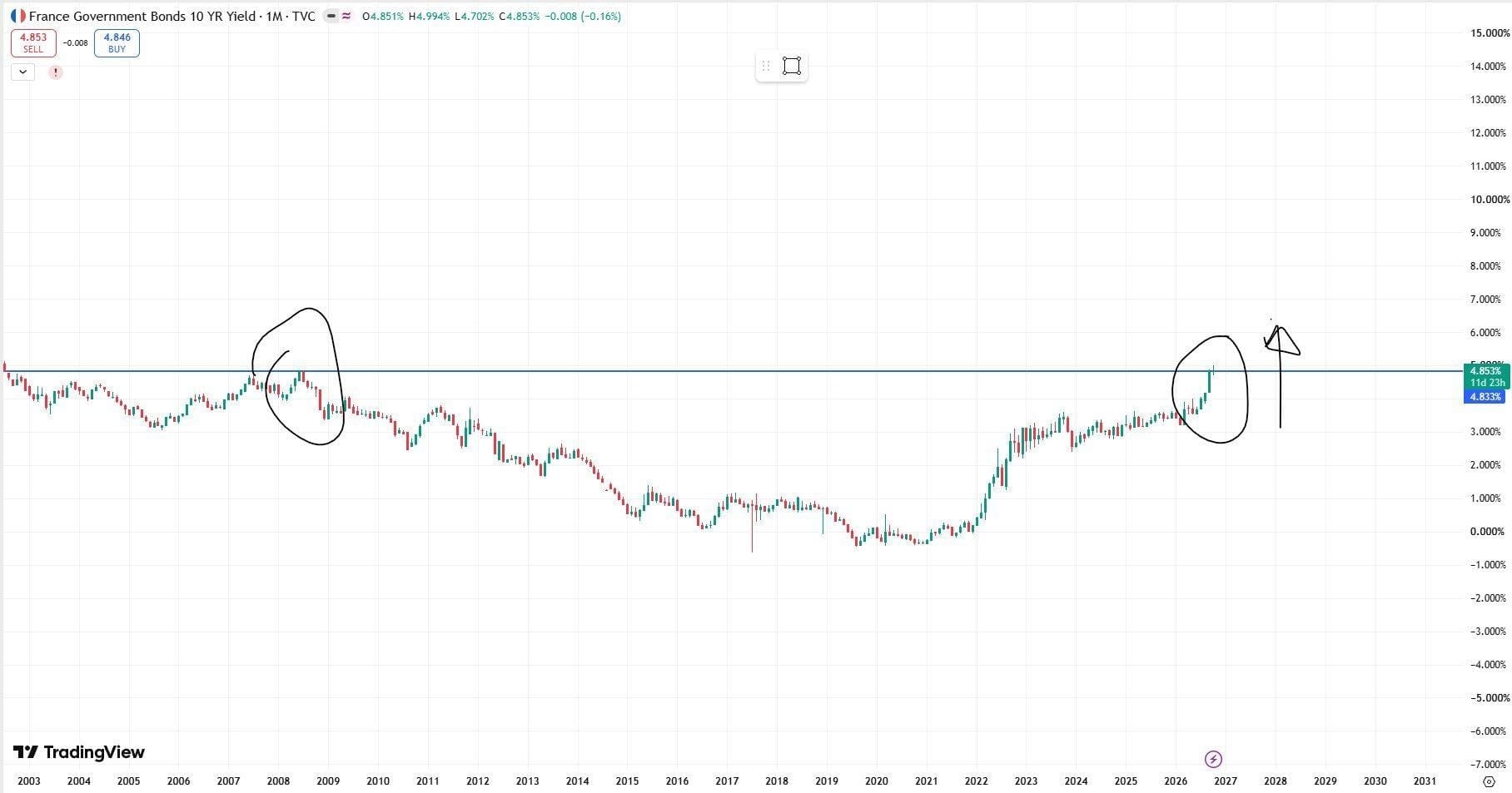
France 10-year government bond yield, monthly, 2003 to 2026. Chart: TradingView (TVC:FR10Y).
To be fair, not all of this is France's doing. German yields are also near 17-year highs because of the energy shock from the US–Iran conflict and stubborn inflation. What's different about France is the gap to Germany. A spread of about 143 basis points means investors want roughly 1.43 percentage points more yield to hold French debt instead of German debt. For years that gap sat around 60.
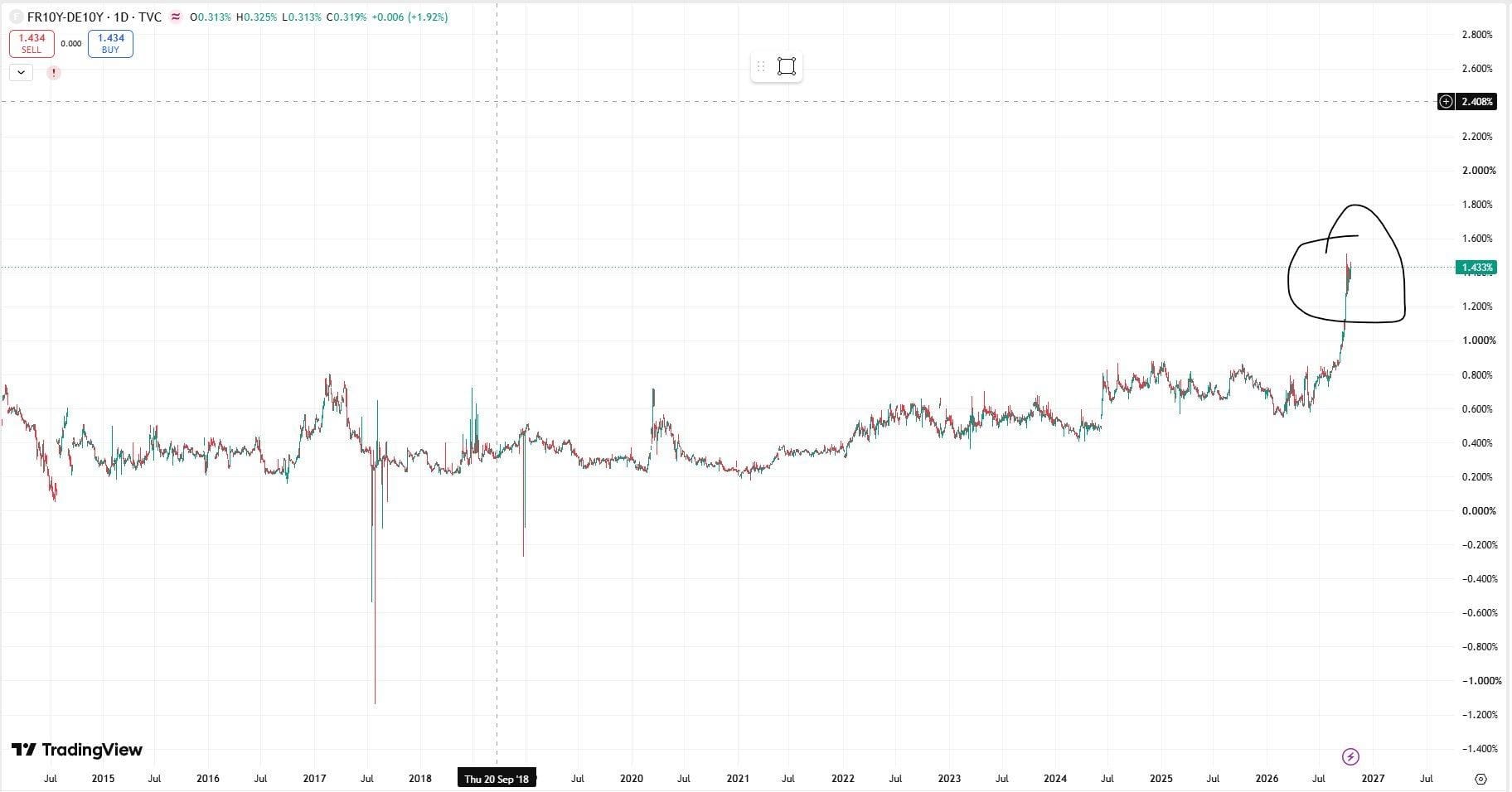
France 10-year minus Germany 10-year yield spread, daily, 2014 to 2026. Chart: TradingView (TVC:FR10Y-DE10Y).
Interest rates: the ECB is stuck in the middle
The European Central Bank has already raised rates twice this year because of energy-driven inflation. Markets are pricing in one more 25 basis point hike by December, and at least one policymaker has said a move this month can't be ruled out.
France makes this harder. A central bank doesn't want to keep pushing rates up while one of its biggest members is going through a bond sell-off. When French yields jumped early in October, traders did trim their ECB hike bets a little. If things get worse I'd expect more talk about the ECB's bond-buying backstop, but I wouldn't expect it to be used unless the spread widens a lot more.
The US adds to the problem. Hot US inflation numbers pushed Treasury yields up and raised bets on more Fed hikes. That drags yields up everywhere and makes borrowing more expensive for France too.
Currency: the euro takes a hit
The euro has been soft since the start of October. When the French spread went past 140 basis points, investors sold the euro, and it fell below 1.1215 against the dollar on 1 October. A stronger dollar, thanks to US rate expectations, hasn't helped.
On the chart, EUR/USD is back around 1.12 after trading near 1.20 earlier this year. That zone also lines up with the highs of 2023 and 2024, so a lot of traders will be watching to see if it holds. France alone isn't enough to break the euro. So far the damage is about confidence. For a much bigger fall I'd want to see something like a vote that brings down the government, a rating downgrade, or the spread jumping again.
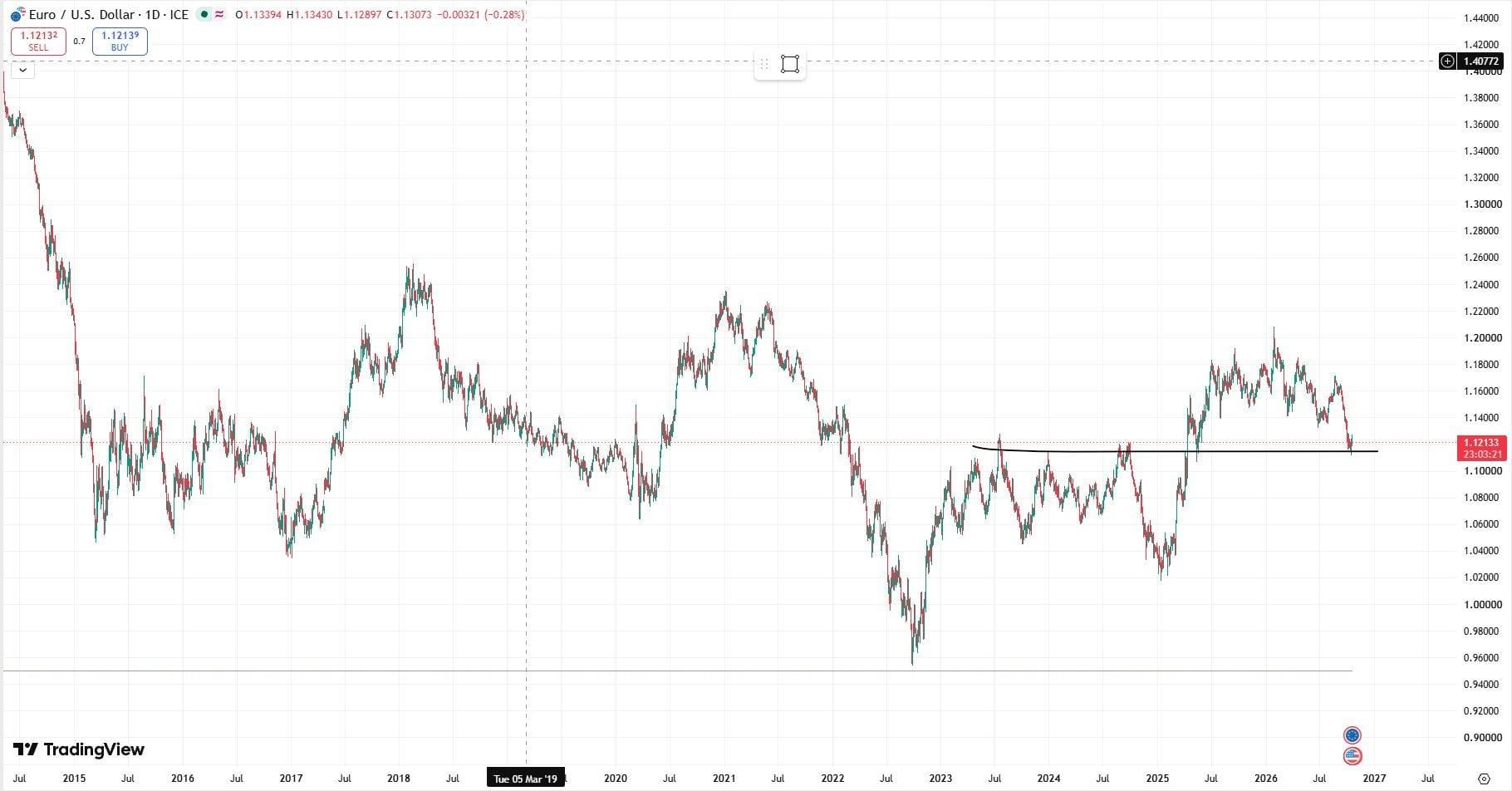
EUR/USD, daily, 2014 to 2026. Chart: Trading View (ICE: EUR/USD).
Stocks: banks feel it first
French stocks have slipped but haven't collapsed. The CAC 40 is about 9% below its August record. Banks feel it most. They hold a lot of French government debt and borrow in the same market, so when the OAT sells off, bank shares tend to follow. Defence stocks have held up better, helped by tensions in Ukraine and the Middle East.
Higher yields hurt shares in general. When a government bond pays close to 5%, shares have to work harder to look attractive, especially the expensive ones. The wider European market has been more resilient so far, and the STOXX 600 has risen on days when the CAC 40 fell.
What to watch this week
First, how French yields open on Monday. Capital Economics said they could jump by as much as 0.1 percentage point, which would put them back near the October highs. Second, the budget vote in the National Assembly. Third, any move on France's credit rating. And one quieter thing: if German yields keep falling while French ones rise, it tells you money is running to safety instead of being sold across the board.
The longer story is tougher. Macron can't run again, elections are due in 2027, and every party knows spending cuts are unpopular. That's why a lot of analysts think the market will keep asking for a premium until there's a credible plan.