Crypto Option Strangle: How Does the Options Strangle Strategy Work?

The fun part about crypto options is that you do not always need to be firmly on the bullish or bearish side, you can simply take advantage of the volatility the crypto market offers and earn profits in either scenario. The crypto option strangle strategy we discuss in this article today is one such tactic to help you profit off of the volatility of crypto.What is the crypto options strangle strategy, and how does it work? Let’s discover.
What is a Strangle Options Strategy?
An option strangle happens when you hold a position in both call and put options in the same crypto with differing strike prices, while both have the same date of expiration. It is quite similar to a straddle, the only difference being that a straddle uses both call and put options at the same strike price, while strangle in options uses options with different strike prices.What is an option strangle strategy good for? If you think a crypto, like Bitcoin for example, could experience a significant price movement in the coming times, but are not sure whether it would go upward or downward, you can try out the crypto option strangle.
Types of Options Strangle Strategy
There are two primary types of strangle: the long strangle and the short strangle options. Here’s what they entail:
The Long Strangle Options
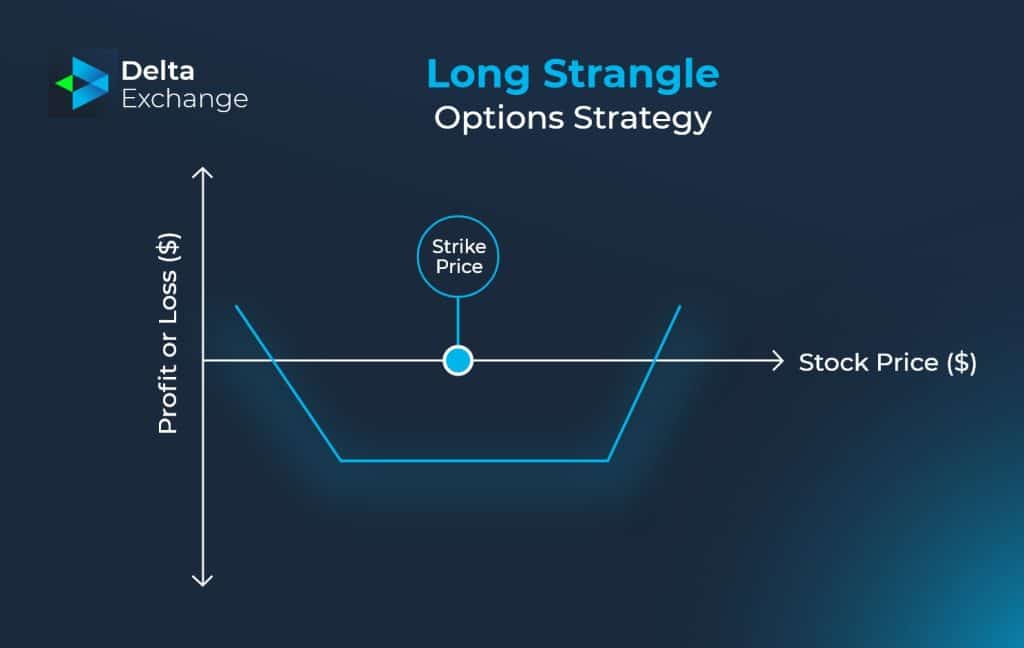
This is the more common strangle in options deployed by traders. Basically, if you believe that your crypto is about to have a significant price change soon, you have to buy call and put options in that crypto with different strike prices, so you can reel in profits from either of the two positions. Remember that the long strangle options strategy carries significant risk as it needs you to get the timing just right to earn profits. You have to gain a good understanding of the asset’s value and its market movements and past trends to be able to predict its upcoming price changes with maximized accuracy.
The Short Strangle Options
The short option strangle, on the other hand, involves selling calls and puts in the same crypto at different strike prices. The short strangle options allows you to receive options premiums from the sell, and if you predict market movements right, the premiums you receive could be more than the overall price shift of the crypto underlying.
How Does an Option Strangle Strategy Work?
Now that we know two types of crypto option strangle strategies, here’s a step by step look at how strangle options work:
- Firstly, those making crypto option strangle trades need to identify two different strike prices on the same crypto: where one will have a strike price higher than the current market price of the crypto, and the other one will need to have a lower price than the current market value. This range is important for determining the final strike prices for the execution of the strangle options strategy.
- Once these two strike prices are picked, traders can either buy or sell two call and put options at these strike prices.
- The goal of crypto option strangle is to determine a range within which the underlying crypto’s price might keep in the future. If the price does indeed stay range-bound, it’s a win for those with short option strangle strategies. On the other hand, if the price goes beyond the range, those with long strangle options strategies will earn gains.
How are an Option Strangle and Straddle Different?
To elaborate upon the previously discussed similarities and differences between a crypto option strangle and straddle, while both allow you to earn profits from significant market volatility, there are quite a few differences between the two to note.Here’s a detailed look at the differences of a crypto option strangle and straddle:
| Crypto Option Strangle | Crypto Option Straddle |
| A long strangle in options involves buying out-of-the-money options (a call where the current price of the crypto is below the strike price, and a put where the current market value of the crypto is above its strike price). | A long crypto option straddle involves buying at-the-money calls and puts (the strike prices are the same as the crypto’s market price) instead of out-of-the-money options. |
| With the long strangle, traders need to hope for a big move outside of the range set by the strike prices of their call and put options to earn a profit. | In the straddle, you profit when the price of the underlying crypto rises or falls from strike price by an amount that is more than the total value of the premium, so the price shift traders hope for is not as big. |
Benefits of Options Strangle Strategy
Here are some of the benefits a crypto options strangle offers:
- When you try the options strangle strategy, you don’t need to worry about predicting the future direction of the market wrong. Unlike those with stakes in either call or put options, you can stay safe from directional risks.
- Out-of-the-money options have lower intrinsic value than at-the-money options, which means long strangle in options requires less capital than other crypto option trading strategies, allowing you to diversify and put your money in other trades.
- If you are trading in short strangle options, i.e. if you are the one selling calls and puts for the same crypto at different strike prices, you have access to funds that you can put into further trades, again giving you a similar benefit to long strangles.
Frequently Asked Questions (FAQs)
Q1: What is a strangle options strategy in crypto?
A strangle involves buying or selling an out-of-the-money call and put on the same asset with the same expiry. A long strangle profits from large moves in either direction; a short strangle profits if price stays within a defined range until expiry.
Q2: How does an options strangle strategy work?
In a long strangle, a trader buys an out-of-the-money call and an out-of-the-money put at the same time. A large enough move in either direction lets one leg cover the total premium and generate profit. In a short strangle, you sell both options and keep the premium if price stays range-bound through expiry.
Q3: What is the difference between a strangle and a straddle?
A straddle uses at-the-money options for both legs, costs more, but needs a smaller move to profit. A strangle uses out-of-the-money options, reducing upfront cost but requiring a larger move. Traders pick strangles when expecting strong volatility but wanting to keep premium outlay lower.
Q4: What are the types of options strangle strategies?
The two main types are the long strangle, buying an OTM call and put to target large moves, and the short strangle, selling both to collect premium in stable markets. Some traders use asymmetric strangles with unequal strike distances to reflect a directional bias.
Q5: When should traders use a strangle options strategy?
Long strangles work well before major events where a big move is likely but direction is unclear. Short strangles suit stable, high implied-volatility environments where price is expected to stay range-bound. Delta Exchange provides multi-leg tools to build, price, and monitor strangle positions efficiently.
Q6: What are the benefits of a strangle strategy in crypto trading?
Long strangles cost less than straddles because both strikes are out of the money, while still offering meaningful upside during sharp moves. In crypto, where volatility spikes around news events, traders on Delta Exchange can use strangles to position for movement without picking a direction.