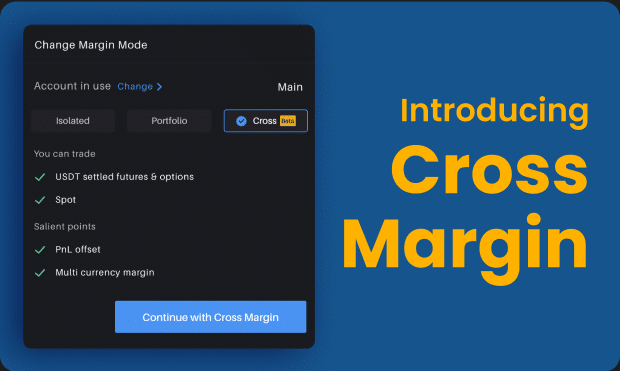
Cross Margin Trading on Delta Exchange: Cross vs Isolated Margin Explained

Cross Margin is one of two margin modes available for trading crypto futures and options on Delta Exchange - the other being Isolated Margin. In Cross Margin mode, your entire available account balance acts as shared collateral across all open positions and orders, instead of each position drawing from its own fixed margin allocation. This guide breaks down how Cross Margin works, how it compares to Isolated Margin, the specific advantages it offers active traders - including multi-currency collateral and PnL offsetting - and the exact steps to enable Cross Margin on Delta Exchange.
Cross Margin is a margin mode where all funds in a trading account are pooled together as shared collateral for every open position. Instead of assigning fixed margin to each trade, it automatically applies the highest allowed leverage, uses only the minimum required margin per position, and offsets unrealized profit against unrealized loss across the account.
What is Isolated Margin?
Isolated Margin assigns a fixed, separate amount of collateral to a single position or order - effectively treating it like its own sub-account. If that position is liquidated, only its allocated margin is at risk; the rest of your balance and your other open positions remain untouched.
Salient properties:
- You can select the leverage at which you wish to run positions/ orders in a contract. Margin requirement is driven by the selected leverage
- The loss that you can incur in a position is capped at the margin assigned to the position
- Liquidation of position in a contract has no bearing on your other open positions. Any balance available that is not explicitly assigned to a position will not be automatically utilized to prevent its liquidation
What is Cross Margin?
Cross Margin is a margin mode where collateral across the account is shared among all open positions and orders. Rather than manually allocating margin per trade, it automatically applies the minimum required margin at the highest allowed leverage - freeing up capital and lowering the risk of any single position being liquidated in isolation.
Salient properties:
- All positions run at the highest allowed leverage - at any time, only the minimum required margin is allocated to each position or order.
- Shared margin unlocks offsetting of unrealized PnL: unrealized loss in one position can be offset by unrealized profit in another.
- Liquidation becomes an account-level event, triggered only when the account doesn't have sufficient funds to meet maintenance margin requirements across all positions.
Key differences between Cross and Isolated
| Cross Margin | Isolated Margin | |
| Leverage | Automatically uses the highest allowed leverage | Trader has to manually choose the leverage before placing the trade |
| Auto Top Up | Not required, since margin allocation to position/ orders is dynamic | Trader can enable auto top up feature to automatically add more margin to a trade |
| PnL offsetting | The unrealised profit from an open position can be used to support a loss making position or to place new orders. | All positions are independent of each other. |
| Liquidation Handling | Automatically utilizes the entire available balance to prevent liquidations. Hence, the entire account will be liquidated in case of liquidation. | Limits loss to the initial margin assigned to a position. Only the specific position will be liquidation in case of liquidation. |
How Is Cross Margin Better? Key Benefits of Cross Margin Trading
- Effective Leverage: Cross Margin always allocates margin at the max possible leverage for all your positions, enabling you to utilize your available margin more efficiently. Also, by utilizing your entire account balance, you have the flexibility to take larger positions without worrying about individual margin requirements.
- Multi currency collateral: Cross Margin also includes the multi-currency collateral system in which the dollarised values of coins other than USDT are included in the USDT Collateral Available. This means that balances in coins like BTC and ETH can be used as margin for trading in USDT settled contracts.
- PnL Offsetting: The unrealised profit from an open position can be used to support a loss making position or to place new orders minimizing chances of liquidation.
- Long option value: The value of long options positions also add to the available margin. A natural corollary of this is that if you are looking to acquire both long and short options positions, acquiring long options positions first would be advantageous from margin requirement perspective.
- Simplified Management: With Cross Margin, you don't need to allocate separate margins for each position manually. The platform automatically handles the distribution of margin, making it more convenient and efficient to manage your trades.
How to Enable Cross Margin on Delta Exchange?
- Visit the Options/Futures page: Margin mode is an account level property. You can have one of the three margin modes for your main account as well as sub account. By default, Isolated margin mode will be selected for your accounts.
- Click on the margin mode button

- Select “Cross margin”
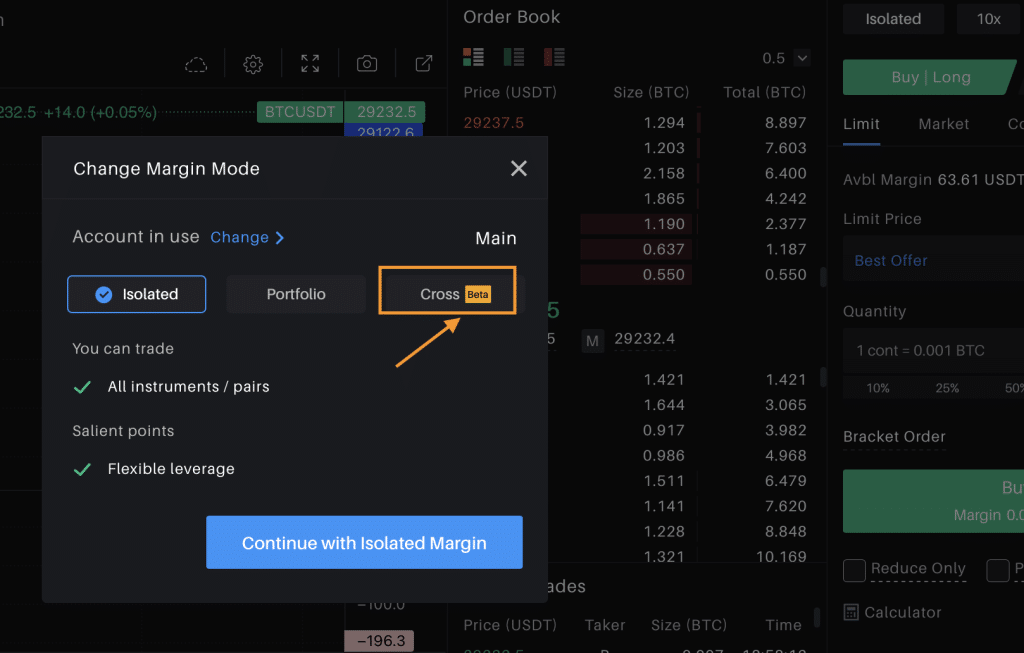
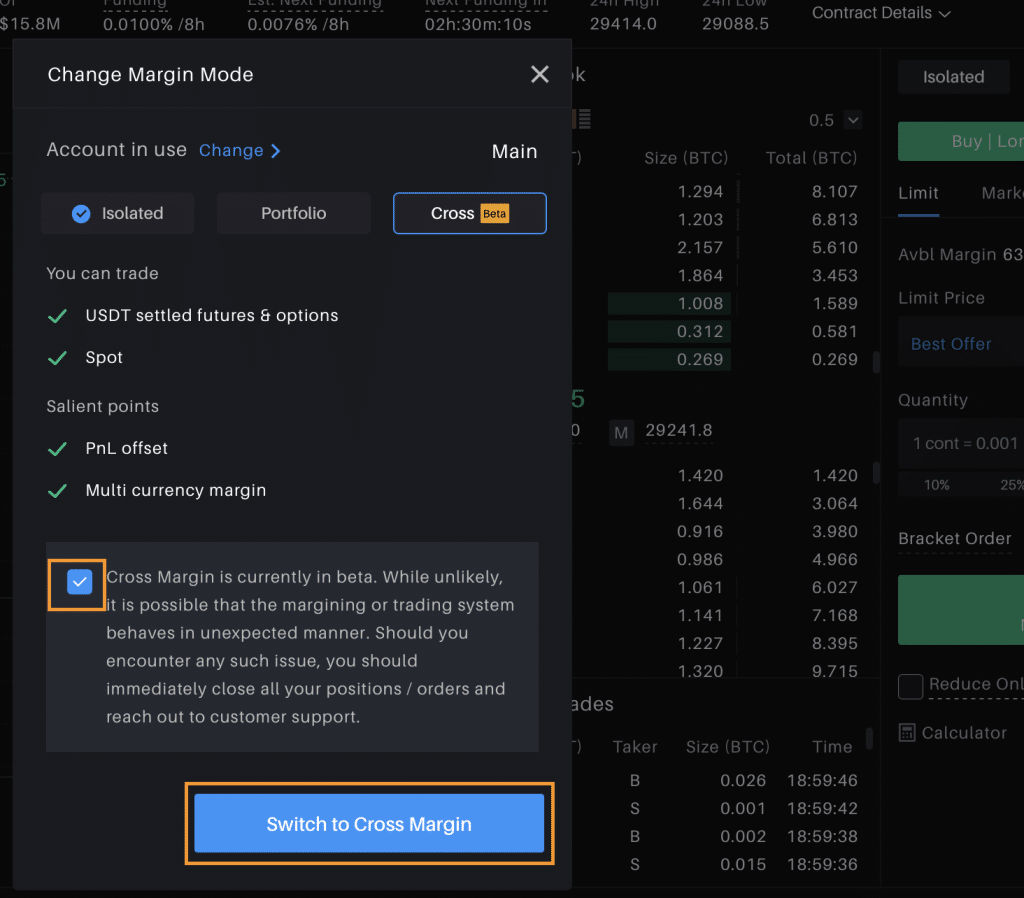
- Click on “Switch to Cross Margin”
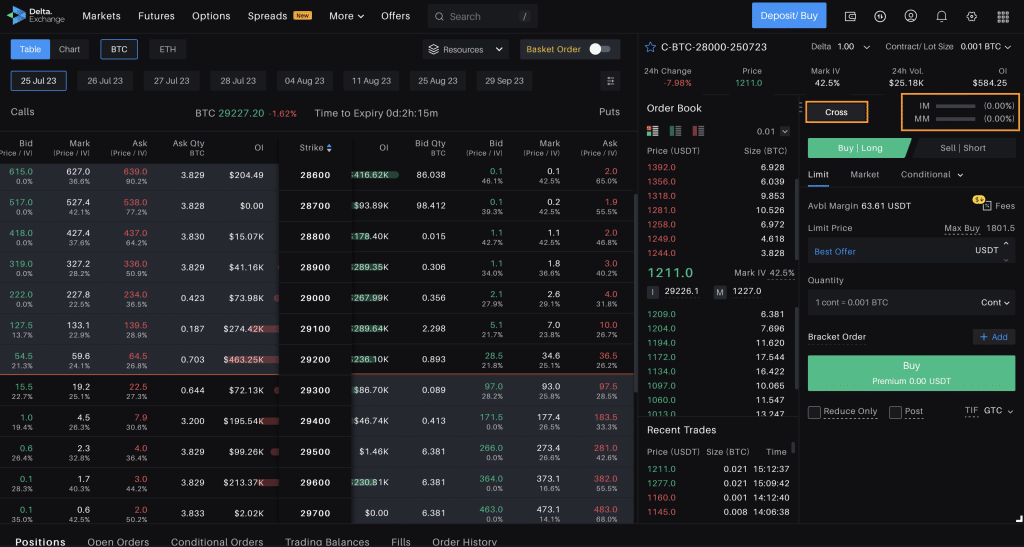
Cross margin gets enabled and you will be able to see the IM (Initial Margin) and MM (Maintenance Margin) bars. This will indicate how much initial margin you need to open a fresh position and the margin requirement to keep a position open respectively. If the MM bar reaches close to 100% your account will get liquidated. Hence, you should keep a tab on this bar and add more margin into your account to avoid liquidation.
Conclusion
Choosing between Cross Margin and Isolated Margin comes down to how much risk control you want at the position level versus how efficiently you want to use available capital. Cross Margin suits traders running multiple positions who want automatic leverage optimization, multi-currency collateral support, and PnL offsetting across their portfolio. Isolated Margin suits traders who prefer to cap risk on individual trades. Delta Exchange supports both modes at the account level, so you can choose the approach that fits your trading strategy - switch to Cross Margin from the Options or Futures page and keep an eye on your IM and MM bars to manage liquidation risk effectively.
Frequently Asked Questions (FAQs)
Q1: What is isolated margin in crypto trading?
Answer: Isolated margin allocates a fixed amount of collateral to a single position. If that position is liquidated, only the allocated margin is lost. Your remaining balance and other open positions stay untouched. It suits high-leverage speculative trades where you want tight, per-trade risk control.
Q2: How does cross margin mode work?
Answer: In cross margin, your entire available balance acts as collateral for all open positions at once. Unrealized profits from winning trades offset losses on others, lowering portfolio-level liquidation risk. The downside is that one runaway losing position can drain your entire account balance without a hard cap.
Q3: What are the key differences between cross and isolated margin?
Answer: Isolated margin caps risk at the amount allocated to each position. Cross margin exposes the full account balance but provides a larger liquidation buffer. Cross margin suits traders running multiple correlated positions; isolated margin suits traders who want fixed, per-trade risk limits that cannot bleed into other positions.
Q4: How does PnL offsetting work in cross margin?
Answer: In cross margin, unrealized gains on profitable positions reduce the margin requirement on losing ones, helping the account absorb short-term adverse moves. This netting effect lowers total collateral requirements compared to isolated mode, where every position needs its own separate margin buffer regardless of what else is open.
Q5: How does liquidation differ in cross vs isolated margin?
Answer: In isolated margin, a position liquidates when its own allocated margin falls below the maintenance threshold, capping your loss to that amount. In cross margin on Delta Exchange, liquidation triggers when total account equity drops below aggregate maintenance margin, which can close all open positions at once and wipe the full balance.
Q6: How do you enable cross margin on Delta Exchange?
Answer: On Delta Exchange, switch between isolated and cross margin directly from the order panel before entering a trade. Cross margin pools collateral across all open positions in the same margin currency. Always confirm your margin mode before placing a position since it determines how liquidation risk is calculated.