What Are Liquidity Pools in DeFi and How Do They Work?

DeFi liquidity pools are one of the central technologies among the DeFi technology stack currently powering almost all of the top projects within the decentralized finance universe. These liquidity pools can work to enable decentralized trading of cryptocurrencies, crypto lending, generation of rewards in yield farming, and a lot more. In case you are new to the DeFi world and don’t know much about DeFi liquidity pools, in this post we give you a detailed look at this particular attribute of the decentralized finance space, and how they work.
What Exactly is a Liquidity Pool?
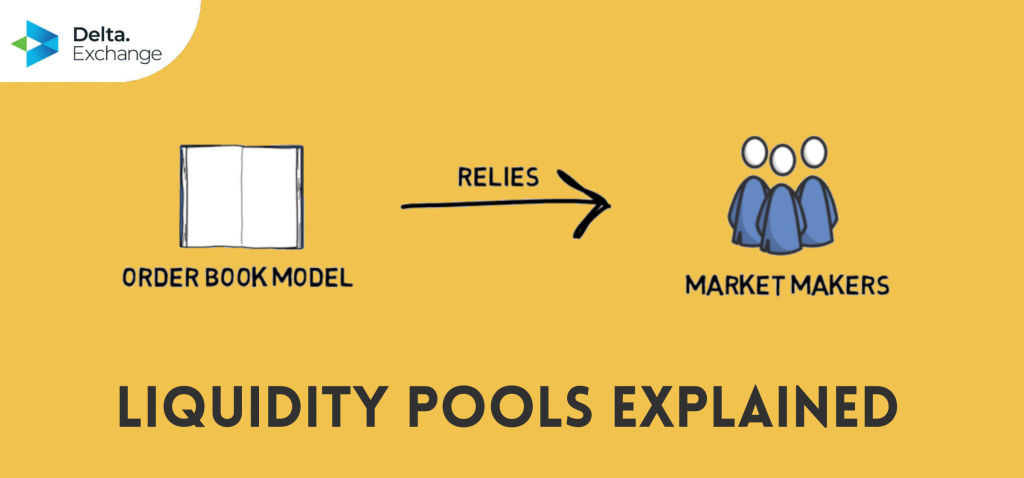
Simply put, a DeFi liquidity pool is a smart contract that keeps crypto tokens locked in to ensure liquidity for the coins on a DEX, or a decentralized exchange. In recent years, as the DeFi space has slowly evolved, liquidity pools have emerged as an automated and efficient way of solving the issue with liquidity plaguing quite a few existing decentralized exchanges. DeFi liquidity pools replace the order book model used by CEXes or centralized crypto exchanges, which is also used in traditional financial systems and services.

Source: Finematics When it comes to an order book, the exchange platform acts as a marketplace where buyers and sellers come together and mutually set prices for various assets based on factors like their supply and demand. The problem with this system is that it entirely depends on there being enough buyers and sellers to create liquidity so that the prices can be kept fair. In case of decentralized exchanges, the order book model has proved quite inefficient; most blockchains can’t really handle the required throughput for the trading of billions of dollars everyday, and the increased gas fees makes the exchanges not very appealing to market makers. However, the DeFi liquidity pools deal with these problems, and offer steady, automated liquidity for decentralized exchange platforms. A liquidity pool, as mentioned before, is a smart contract that locks in a collection of crypto tokens. The users to provide said tokens are called the LPs or the liquidity providers; the LPs have to add an equal value of two (or more) tokens in a DeFi liquidity pool to create a market. In exchange for lending out their funds in the liquidity pools, the LPs earn a portion of the trading fees the DeFi liquidity pools accumulate, in direct proportion to the amount of liquidity they have provided.
How Do Liquidity Pools Work?
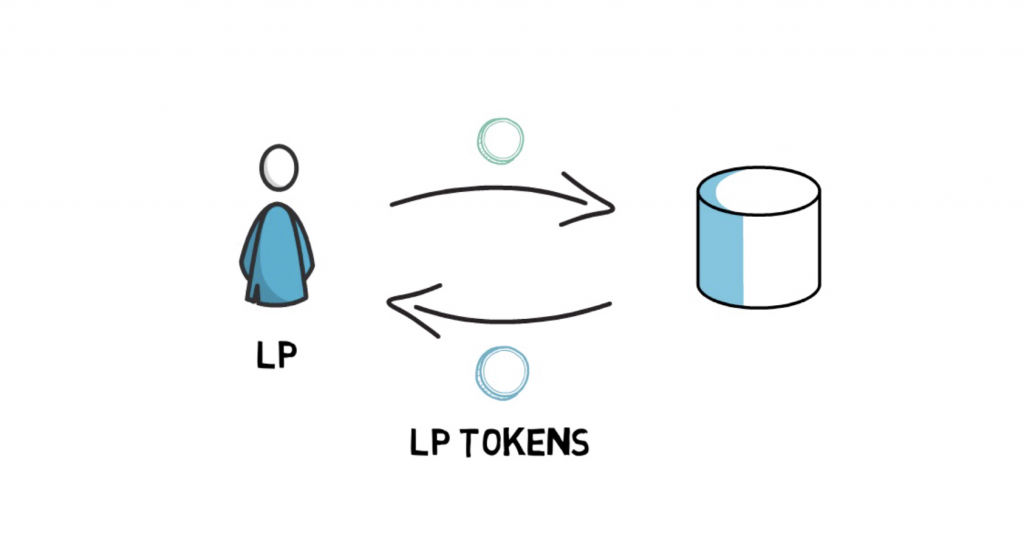
The simplest version of a DeFi liquidity pool would hold two tokens in the smart contract so a trading pair can be formed. The LPs have to contribute an equal value of both tokens to the liquidity pool. The liquidity in the pool means that when a user wants to trade one of the tokens in it for the other, they will be able to do so based on the already deposited funds, instead of waiting around for a counterparty who would match their trade. The price of the assets in a liquidity pool is determined by a pricing algorithm that constantly adjusts based on the pool’s trading activity. When liquidity providers deposit their own tokens in a liquidity pool, they receive newly minted pool tokens that represent their stake. As mentioned earlier, the liquidity providers get to earn a portion of the pool’s trading fees as reward for their services. And if a liquidity provider wants to withdraw their stake in the liquidity pool, they can simply burn their pool tokens to do so. For instance, let’s assume a pool is made up of ETH (Ethereum) and USDC (USD Coin) tokens. Now, since the price of an ETH is equal to around 2,300 USDC as of April, 2021, an LP who wants to deposit 1 ETH in the pool would need to match it with 2,300 USDC as well. And in the case of this particular DeFi liquidity pool, the pool token LPs would receive would be USDCETH.
What Are the Benefits of DeFi Liquidity Pools?
The very first advantage the liquidity pool model has over traditional order books is that they provide a continuous supply of liquidity for the traders coming up on decentralized exchange platforms. Plus, if you are or intend to become a liquidity provider, you’d obviously get to earn a portion of the transaction fees. Many DeFi platforms also offer additional incentives to the LPs so that the token reserves on their liquidity pools remain large; for example, platforms like Uniswap, Balancer, and Yearn.finance give out their native platform tokens to the liquidity providers as rewards. In many cases, these native coins can only be acquired by providing liquidity to the respective platforms and not on open markets, which gives LPs the opportunity to hold a rare asset. When the liquidity pools remain broad, the risks of slippage are reduced greatly, creating a much better trading experience for users on the platforms.
And Now, What are the Risks Associated with DeFi Liquidity Pools?
Since most of the DeFi world is pretty new, like all other aspects of it, DeFi liquidity pools also come with a few associated threats. Firstly, there are risks of smart contract failure. In case the underlying code isn’t audited or fully secure, you could risk losing your deposited coins. This is a risk you should be aware of before you lend out any funds to a DeFi liquidity pool. Because of the pricing algorithm, smaller liquidity pools can still suffer from slippage issues if a user wants to place a large trade. And in the case of token price fluctuations, LPs can suffer a loss in the value of their deposited tokens; this is known as an impermanent loss. Based on the size of the price fluctuation and the duration through which an LP stakes their deposit, the impermanent loss might be offset partially or fully with the rewards, but if the LP chooses to withdraw their deposit, the loss becomes permanent. And there you have it, everything you need to know about DeFi liquidity pools in one place! We hope you found this post informative! And if you’d like to find out more about new DeFi projects to invest in, crypto options trading, and the world of cryptocurrencies in general, do give our blog a visit!
Frequently Asked Questions (FAQs)
Q1. What is a DeFi liquidity pool?
Answer: A DeFi liquidity pool is a smart contract holding token reserves that traders swap against directly. Prices are set algorithmically by an AMM formula - no counterparty, no order book.
Q2. How do liquidity pools differ from the traditional order book model?
Answer: Order books match discrete buyers and sellers; liquidity pools let trades execute against a pre-funded reserve anytime. Large trades incur slippage - a trade-off centralised order books handle more efficiently.
Q3. Who are liquidity providers and how do they earn rewards?
Answer: Liquidity providers deposit token pairs, receive LP tokens representing their share, and earn 0.05%-1% of every swap fee. Many protocols add governance token incentives on top of base fee revenue.
Q4. How is the price of assets determined in a DeFi liquidity pool?
Answer: Most pools use the constant product formula (x × y = k). Buying a token shrinks its reserve and raises its price; arbitrageurs then realign pool prices with external market rates.
Q5. What are the benefits of using DeFi liquidity pools?
Answer: Liquidity pools offer permissionless trading, no KYC, instant on-chain settlement, and passive swap-fee income. They underpin decentralised derivatives, lending, and stablecoins - the foundational infrastructure layer of DeFi.
Q6. What is impermanent loss and how does it affect liquidity providers?
Answer: Impermanent loss occurs when deposited token prices diverge post-deposit. The AMM sells the appreciating token to rebalance, leaving LPs worse off than simply holding. It reverses only if prices return to the original ratio.
Q7. What are the key risks associated with DeFi liquidity pools?
Answer: Key risks include impermanent loss, smart contract exploits, oracle manipulation, and stablecoin depeg. The Terra/UST collapse (May 2022) showed how quickly LPs can suffer near-total losses during a depeg event. Traders preferring regulated derivatives can explore Delta Exchange's on-chain settled contracts instead.
Q8. What is better, staking or a liquidity pool?
Answer: Staking offers predictable returns with no impermanent loss; liquidity pools offer higher potential yields with greater complexity and risk. Risk-averse participants favour staking; LP positions suit those comfortable actively monitoring DeFi exposure.