What is Polkadot?

Polkadot is a scalable, multi-chain protocol that connects multiple blockchains. This way, Polkadot allows for information and assets to be moved across blockchains that were previously incompatible (such as Bitcoin and Ethereum) in a trustless way. Polkadot’s notable features include its use of ‘parachains’ or parallel blockchains; these chains share the processing load of the main Polkadot blockchain. This allows the network to be quite speedy and scalable, in comparison to most of its contemporary blockchains. There’s also the Polkadot token, or the DOT token, which acts as the governance token of the Polkadot blockchain. The DOT token is used for staking and to distribute Polkadot governance rights, among other things.
Who created the Polkadot crypto project?
Polkadot’s open-source code is maintained by the Web3 Foundation, which is a Swiss Foundation dedicated to the creation of the decentralized web. The developer-team behind Polkadot includes Gavin Wood- a co-creator of Ethereum and one of the founding figures in the world of blockchain. As Polkadot’s co-founders, there are also Robert Habermeier- a prominent figure in the Rust programming language community, and Peter Czaban, who is the Technology Director of the Web3 Foundation.Polkadot was launched on May 26, 2020.
Features of the Polkadot crypto
The Polkadot crypto network is a Substrate-based protocol: Substrate is the core blockchain framework on which most of the aforementioned parachains will be built. Substrate allows developers to build and launch a blockchain with complete ease, with its wide array of various developer-friendly instruments- such as governance tools, WebAssembly smart contracts, encrypted transactions and state, multi-level permissioning, and account-level locking.
Polkadot consensus mechanism
The consensus mechanism used by the Polkadot crypto network is NPoS or Nominated Proof of Stake. Holders of the Polkadot crypto- or the DOT token- can participate in staking and earn rewards for it.
The structuring and working of the Polkadot crypto network
To solve the scalability and interoperability issues many other blockchains face, Polkadot brings a sharded ecosystem that encompasses a main ‘relay chain’, and multiple ‘parachains’ or ‘shards’, as mentioned above. The relay chain works to achieve consensus and deliver transactions among the parachains. The Polkadot relay chain essentially connects all these parachains by sharing state and validation logic, and also maintains a shared security model. The parachains, on the other hand, are separate, application-specific blockchains with their own logic and features. However, they share security features and software with other Polkadot parachains. There’s also a connecting layer or the ‘bridge’ which facilitates the transfer of value and information between blockchains. Moreover, the bridge can even connect to non-blockchain databases, should the requirement arise. According to several tests conducted by the Polkadot crypto network, with the help of parachains, the ecosystem should be able to process as many as a million transactions per second in the near future.
What is Polkadot staking?
With the NPoS consensus mechanism, there are many ways a holder of the DOT token can choose to interact with the staking system on Polkadot. Depending on multiple factors like how much time one is willing to devote to the Polkadot network and how many DOT tokens one can afford to stake, there are four primary roles one can play in the Polkadot network staking system:
- Validators: A validator has significant responsibilities to bear, plus they need to be in the know about the technical stuff. To become a Polkadot validator, first you need to run a node around the clock, and you also have to stake a good amount of DOT tokens. While you get rewarded with newly minted DOT tokens and a portion of the network transaction fees as a validator, you also risk forfeiting your staked DOT for making mistakes or any malicious activities.
- Nominators: Since becoming a validator requires you to stake a large amount in DOT tokens, not many can afford it. However, you can still earn DOT tokens by staking fewer tokens and ‘nominating’ one or several validators. Thus, you become a nominator for validators you choose, and delegate some of your DOT tokens to them. In exchange, you get a portion of the DOT tokens your chosen validators earn as reward.
- Collators: Those staking DOT tokens to be charged with keeping track of all valid parachain transactions and submitting them to the relay chain validators are called the Collators.
- Fishermen: Finally, you can stake DOT tokens to find and report any suspicious behavior across the Polkadot ecosystem as a Fisherman.
The DOT tokens won as rewards will give each of the aforementioned users a say in the Polkadot crypto network governance. They can propose new ideas for the working and improvement of the network, and vote on ideas raised by others.
What are some risks associated with Polkadot investment?
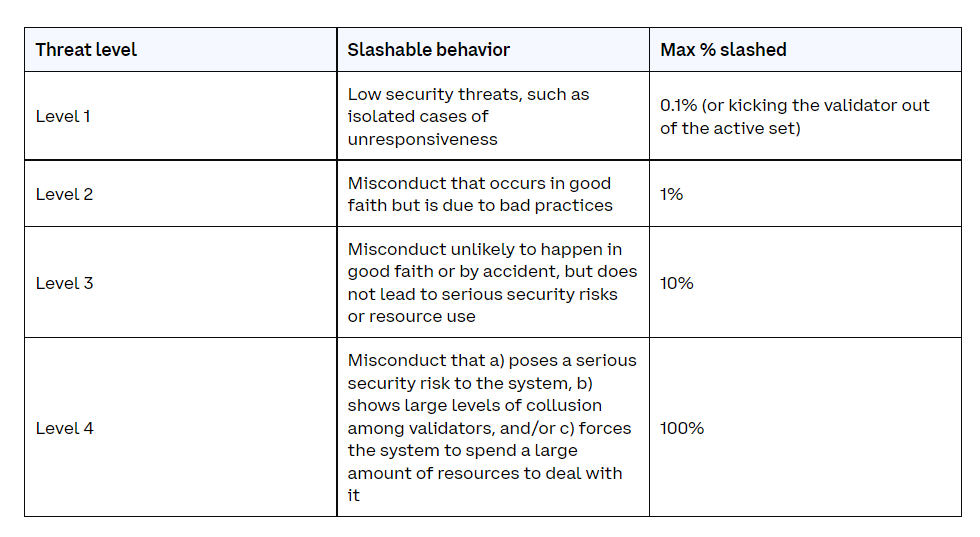
As a Polkadot validator, as mentioned above, you can be slashed for any sort of misbehavior, which includes things like unresponsiveness, going offline, technical difficulties, and equivocation (the act of producing two blocks in the same slot, or sending contradictory pre-vote messages for two chains at once). The slashed amount is always a fixed percentage of one’s total stake. It’s important to keep in mind that a validator with more DOT tokens staked will be deprived of more total DOT tokens in case of any misbehavior. Therefore, there is no fundamental advantage in staking more DOT tokens than other validators. Since the rewards are distributed among all validators in a particular set equally, staking more DOTs would simply increase your losses should you get slashed. Here’s a chart that depicts what kind of slashing a Polkadot validator may face based on security threat levels:
(Source: Coinbase)
Conclusion
The Polkadot crypto network brings many benefits for developers, users, and investors alike. With DOT token staking providing annual yields of 10% on average, Polkadot also brings one of the most rewarding user incentives in the crypto space in recent times. The platform has proven to be reliable so far with its adherence to the roadmap it declared at the time of launch. Going forward, Polkadot is certainly presenting itself as one of the most promising contemporary blockchain projects, both in terms of technological innovation and lucrativeness. Note: You can also trade DOTUSDT & DOTBTC perpetual swaps on Delta exchange with upto 100x and 50x leverage respectively.
Polkadot Crypto FAQs
Q. What is the Polkadot crypto?
A. Polkadot is a blockchain solution that facilitates interoperability between various blockchains, such as Bitcoin and Ethereum. Polkadot follows a proof of stake consensum mechanism called NPoS or nominated proof of stake. The Polkadot crypto DOT can be staked by users on the Polkadot platform for rewards in the form of more DOT tokens and a percentage of network fees.
Q. Does the Polkadot network support oracles?
A. The ‘bridges’ on the Polkadot network act as the native oracles within the ecosystem. Through them, Polkadot can uphold interoperability between even blockchains that are not part of the Substrate blockchain framework Polkadot is based on.
Q. How many Polkadot crypto tokens are there?
A. The native Polkadot crypto coins are called the DOT tokens, which double as governance tokens for the network. Users can stake DOT tokens on the blockchain to earn rewards. While there is no determined limit to the total number of Polkadot cryptos there can be, until one billion DOT tokens are created, the supply is supposed to increase by 10% every year. After that, the DOT inflation rate is slated to reduce with time.
Q. What are some projects based on Polkadot?
A. Polkadot already supports many of the newer, promising blockchain projects. Some of them would be: Kusama: Kusama is Polkadot’s canary network, with a codebase very similar to Polkadot’s. Any network upgrades or new dApps are integrated with Kusama first as a test phase, to see how they might perform on the actual Polkadot blockchain. Acala: A Singapore-based DeFi platform, Acala benefits from the interoperability and developer-friendly environment of Polkadot. Along with aUSD or the Acala Dollar, this platform has already made a decentralized credit platform and a DEX. through Acala, users can trade, lend, and borrow many different cryptos across blockchains. Edgeware: Edgeware functions as a testnet for Polkadot’s on-chain governance. Edgeware provides support for smart contracts, and is compatible with Ethereum. This means Edgeware connects the Polkadot ecosystem to the Ethereum blockchain without any scalability issues.
Q. How many chains can Polkadot connect?
A. So far, there is no limit to the number of chains that the Polkadot ecosystem can connect to. As the blockchain is further developed, the Polkadot design should be able to handle dozens, and maybe even hundreds of parachains.