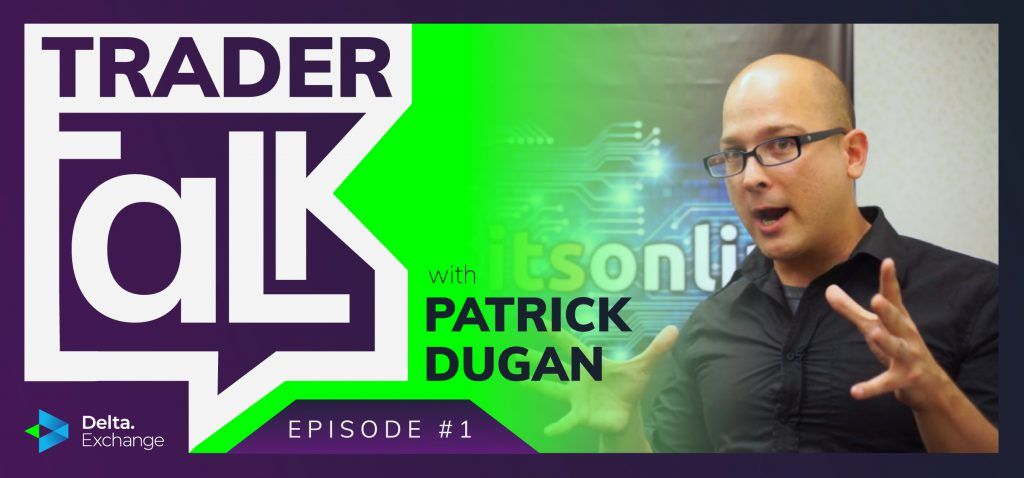
Trader Talk #1: with Patrick Dugan

Becoming a good trader is a long journey for many. Just like history, markets do not repeat themselves, but they often rhyme. Thus, there's much that a new trader can learn from a veteran of many market cycles. It is this belief that has made us start this Trader Talk series in which we intend to pick brains of top crypto traders and learn from them. We are kickstarting this series with a free wheeling chat with Patrick Dugan.
About Patrick Dugan
Patrick Dugan is the founder of TradeLayer,. He writes sci-fi and is a former game designer, consultant in the crypto derivatives industry and a pure-play libertarian firebrand.
How and when did you discover crypto trading?
Patrick: I got interested in trading when I was 13 after my pop told me about trading a press release of a biotech company. I was really into it after that. I got several years experience with stocks, forex and options before buying BTC in the May 2013 dip and then relying on it to recover from being robbed at gunpoint in Argentina. This introduced me to the value of arbitrage.
Please tell us about your trading style.
Patrick: When I was rich I would only do low-risk time-value plays such as Cash Carry on swaps, or maybe some % Covered Calls, for the spice. When I was poor I would trade any shitcoin based on tape-flow during high volume periods, take leverage on BTC, whatever worked for the hustle. I did pretty well manually trading and then in the pit of the 2015 bear market taught myself Javascript and tried writing a trading algo to arb the OkCoin Weekly Futures. Then I got sidetracked with running Omni and other ventures, life issues, et al. but now I'm giving algo trading my all. This year, in my financial decline while funding TradeLayer to the last stand, I've tried leveraged Calendar-spread option portfolios, timing algos that got deployed a bit too late in Q2, curve trading (short swap/long future) and now I'm giving algo Market Making my full efforts. I also do a bit of charting. My approach to charting is simple: Fibonacci interval moving averages. Maybe add the fractals, look at volume divergence, that's causally structural to market pivots and too many over look it. The MAs create a colourful banner that gives a great sense of trend and dynamic support/resistance levels plus when resistance flips to support with a strong close.
Tell us about a recent high conviction trade that went your way.
Patrick: I successfully shorted the triangle breakdown in late September (though subsequently gave back the profits in the ensuing chop) by swallowing my pride about entry, hedging even, and then placing a stop-sell order under the recent 1 Hour fractal formation, to double down and make it a 1x net-short. To my surprise, the trade worked very quickly and I happened to be on the tape when the ~7900 bottom was being formed for a few minutes, and the futures went into severe backwardation. So I covered, caught the bounce, shorted again, repeated, it was a perfect day. Just, serendipitous. Few days are like that. Most of my trades are low-to-medium conviction which is why I like hedging with derivatives and playing options.
Tell us about recent high conviction trade that didn't go as expected
Patrick: I had an interest rate arb going on XRP between FTX and Delta Exchange, I hadn't had time to systematize it and I wasn't thinking clearly enough about operational risk. I just kept the margin at ratios that gave me a margin of movement in XRP equal to approximately, it's higher-side daily movements. Very Myron Scholes of me, I aspire to be a Myronic Hero. Anyway I got margin called on FTX when the thing moved very fast in 15 minutes while I was at a meeting and got my face carved by the subsequent rise after the liquidations. The right way to deal with that, if not with an algo, would have been to place take profit and stop-loss orders ahead of the expected liquidation prices to deleverage the balance sheet in a more orderly way.
What is your 5 year bitcoin price target.
Patrick: One... million... dollars!