
Digital Derivatives – The State of Bitcoin Mining Post Halving

Digital Derivatives is a weekly newsletter bringing you the latest research, information and analytics from the cryptocurrency derivatives space brought to you by Delta Exchange. For last week's edition, click here.
Market Moves
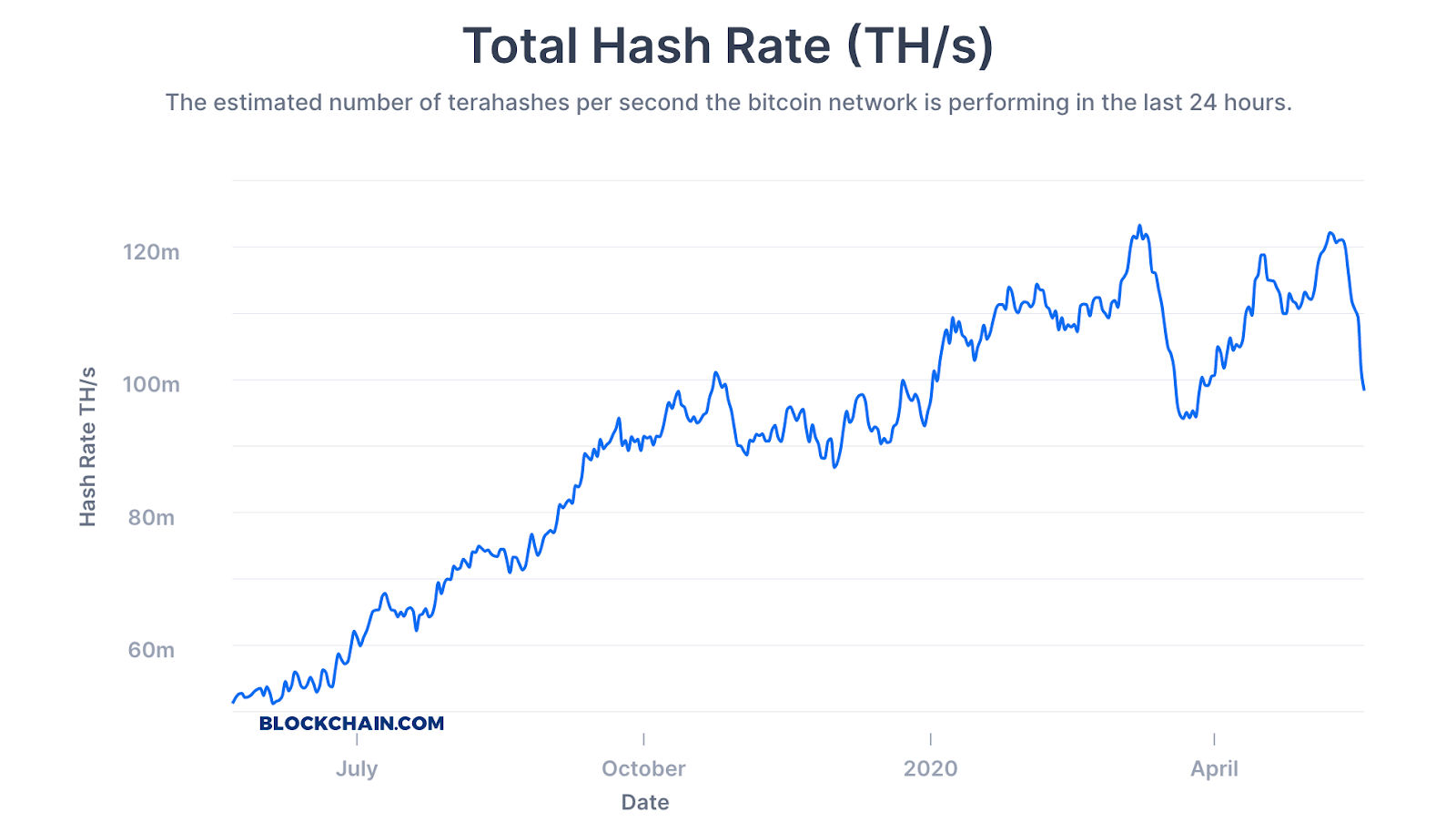
Derivatives Insights Bitcoin Post Halving On May 11th Bitcoin underwent the most anticipated event of the year - its 3rd halving event. Following this event, the Bitcoin block reward decreased from 12.5 to 6.25 BTC per block, effectively slashing the earnings from Bitcoin mining by 50%.This follows the first halving in November 2012 - from 50 to 25 BTC per block, and the second halving in July 2016 - from 25 to 12.5 BTC per block. Bitcoin block reward halves roughly every 4 years, with the 4th halving set to take place in 2024.Here’s how key metrics for Bitcoin have changed since the halving:
| At Halving (11th May) | Now | % Change | |
| Bitcoin Price | $8600 | $9355 | 8.78% |
| Bitcoin Hash Rate | 121.04mTH/s | 94.81m TH/s | -21.67% |
| Block Confirmation Time | 9.75 minutes | 14.25 minutes | 46.15% |
| Average Block Size | 1.23MB | 1.31MB | 6.50% |
| 24h Miner Revenue | $18.56m | $8.46m | -54.42% |
Note that:
- The Bitcoin hash rate is a measure of the processing power of the Bitcoin network, and a proxy for the competitive intensity in Bitcoin mining.
- Miner Revenue is the total 24h value of block rewards and transaction fees paid to miners.
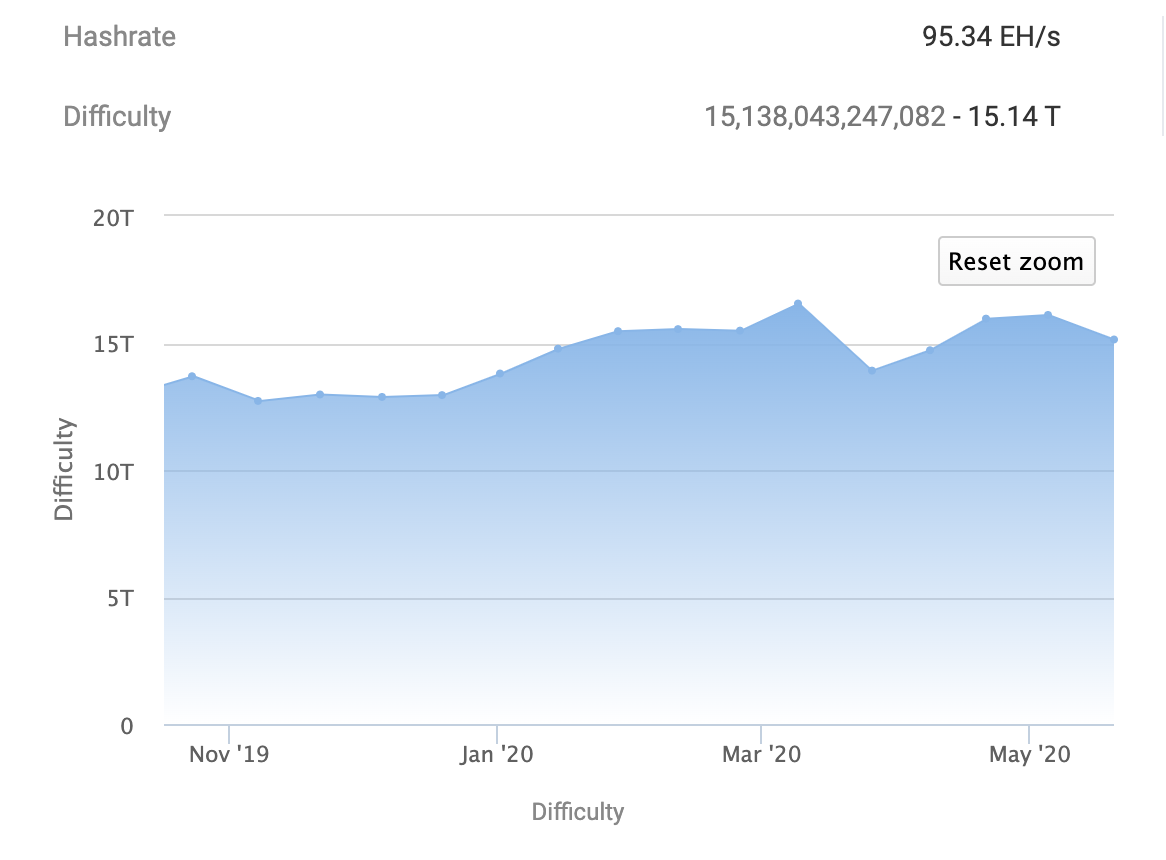
In line with the network hash rate dropping -21.67% post-halving, Bitcoin's mining difficulty decreased 6% to 15.14T on Tuesday (19th May) in the network's first difficulty adjustment post-halving.
Bitcoin mining difficulty measures how difficult it is for miners to compete for a block. A difficulty adjustment takes place every 2,016 blocks - roughly every 14 days - to ensure the interval between mined blocks stays fixed at around 10 minutes. If a large number of miners switch off from the network - as would happen following a block halving event - the interval between blocks becomes longer than 10 minutes and the network adjusts (decreases difficulty) to encourage participation.
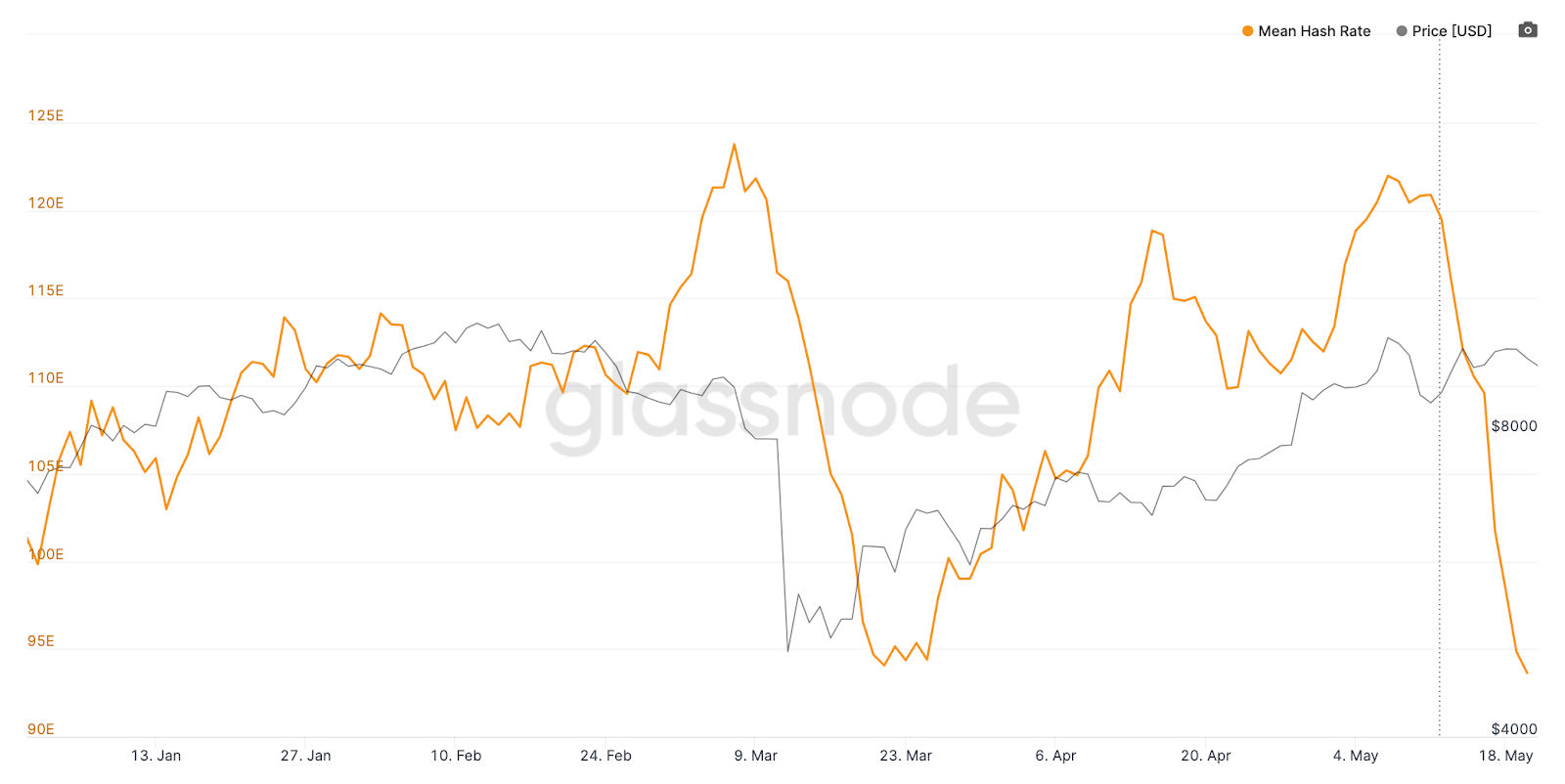
Hash Rate & Price The hash rate of the Bitcoin network tends to follow the price of Bitcoin, closely reflecting miners’ significant sensitivity to Bitcoin price. This is even more true in the aftermath of the block reward halving as the reduction in the number of Bitcoins mined everyday increases the dependence on Bitcoin price rise to maintain margins. [caption id="attachment_25033" align="aligncenter" width="512"]
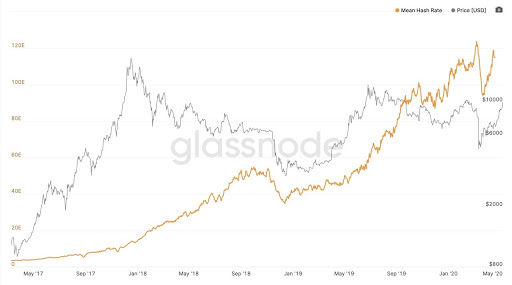
BTC Price + Hash Rate since May ‘17[/caption] A block reward halving - as seen on May 11th - can theoretically be thought of as a 50% fall in the price of Bitcoin for miners, with revenue dropping overnight. As a consequence of this, the hash rate has fallen accordingly (-21.67% since the halving) and is likely to fall further in the near future if not for significant price growth. Falling hash rate is reflective of inefficient miners shutting down due to their inability to mine Bitcoins profitably in the post-halving world. Any volatility in price only exacerbates this situation, with larger players (with more efficient set-ups) surviving to a larger share of the pie. In the medium to long-term however, competition - and subsequently the hash rate - will increase again as difficulty adjusts and new players with more efficient hardware enter the market.
The 2nd Halving - What Can We Learn? 4 years ago, on July 9th 2016, Bitcoin underwent its second network halving where the block reward fell from 25 BTC to 12.5 BTC per block. Bitcoin was up more than 45% in the 3 months leading up to its 2nd halving, before falling 30% - to $530 - in the two weeks after. Bitcoin hit a new high 8 months later before rallying to $20,000 just 17 months later. [caption id="attachment_25039" align="aligncenter" width="1600"]
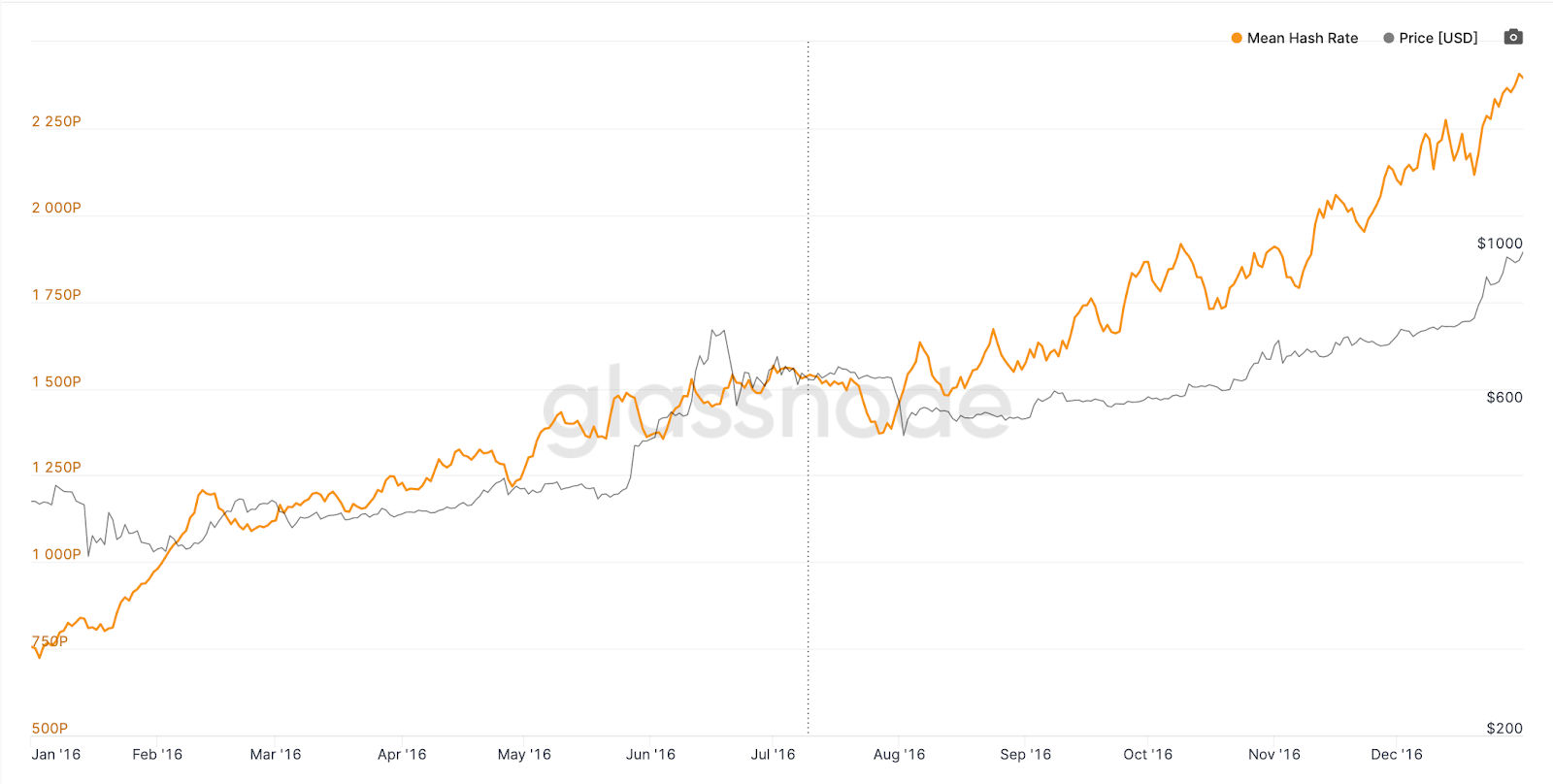
BTC Hash Rate in 2016 - the year of 2nd halving[/caption] Both hash rate and price were generally on a positive run in 2016. The hash rate started the year at 770.5k TH/s, hitting 1.55m on the day of the halving before falling to 1.40m two weeks later. However, in the next two years the hash rate rose exceptionally to 54m TH/s - an increase of over 3757.14%. The hash rate then too was following Bitcoin price action. BTC started 2016 at $435, hitting $632 the day of halving (up 46.7%). In the two weeks after, BTC fell to a low of $549 (-13.97%), before going on a run that would end at $19,990 just 15 months later. This year, the dynamics are different. Bitcoin is currently on a strong run but largely due to an equally strong crash on March 12th. Similarly, the hash rate in 2020 has been volatile, with no clear pattern distinguishable. Bitcoin hash rate has been incredibly volatile throughout the first quarter of 2020, swinging between 90m-125m TH/s. A volatile Bitcoin price and the impending halving are the key factors behind this.
Adjusting To A Halving A Bitcoin halving is an event that is well known in advance, with all future halvings laid out for all to see. Whilst miners prepare for it and make the necessary efficiency adjustments, a near 50% cut in revenues inevitably comes as a big shock regardless of preparations and adjustments are required. To understand the impact of halving, we first need to know the levers of a Bitcoin miner’s revenue.
24h Miner $Revenue = (Miner Hash Rate/ Network Hash Rate) * (BTC Mined/ Day) * BTC_Price
BTC mined per day is determined by the network protocol. After each halving BTC mined per day is cut in half. A miner’s share in the network hash rate can change due to:
(a) increases/decreases in the network hash rate as others parties enter/exit
(b) investment by miners in more and/or better hardware that leads improvements in the miner’s hash rate. Now that we understand the revenue drivers of a Bitcoin miner, let’s analyse how miners adjust to the post-halving world. Fiat denominated revenues are important for a miner because costs are primarily denominated in fiat.
[a] Bitcoin price: A jump in the BTC price can offset the loss in USD revenue due to block reward halving. Ceteris paribus - i.e. hash rate & trxn fees remain unchanged - the price of Bitcoin would have to go up by 98% - to $19998 - for miners fiat-denominated revenue to go back to pre-halving levels.
| Pre-halving | Post-halving | |
| USD Revenue per block mined (Fixed) | $108,790 | $108,790 |
| Block Reward | 12.5 BTC | 6.25 BTC |
| Transaction Fee | 0.15 BTC | 0.15 BTC |
| BTC per block | 12.65 BTC | 6.4 BTC |
| BTC Price (USD Revenue/BTC per block) | $8,600 | $19,998 |
[b] Hash rate: The Bitcoin hash rate is a measure of the network’s competitive intensity. Since halving network hash rate is down ~21.67%% as a consequence of inefficient players shutting down operations. Ceteris paribus, a reduction in network hash rate is similar to increasing the effective price of Bitcoin for miners. In fact, the post-halving reduction in network hash rate can be thought of as a ~27.6% increase in the price of the Bitcoin for the surviving miners.
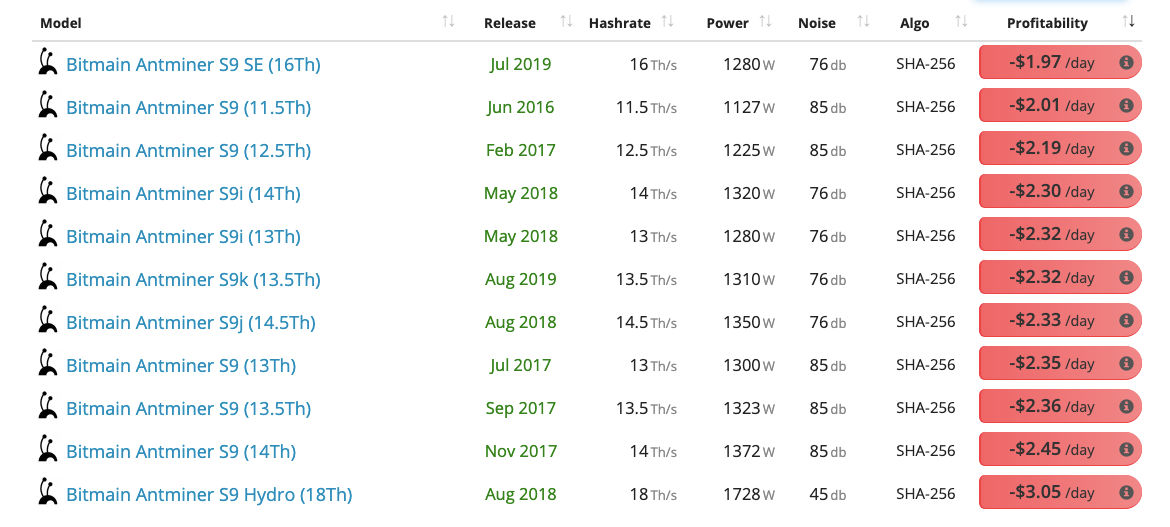
[c] Mining equipment: The changed economics of BTC mining post-halving have made a good fraction of existing mining hardware unprofitable to run. Data from AsicMinerValue shows 45 older generation Bitcoin miners as now being unprofitable. In fact, Antminer S9’s, which account for a large share of existing network hash rate, are unprofitable after the halving. The drop in hash rate indicates that shutting down of inefficient mining equipment is already underway. [caption id="attachment_25029" align="aligncenter" width="1170"]
Source: AsicMinerValue.com[/caption]
So, What’s To Come?
A network halving starts a new CAPEX cycle for miners as they look to move to newer, more efficient mining devices to reduce the cost of producing Biitcoin. Since the halving is known well in advance with complete certainty, we believe that that hardware upgrade cycle would have started a few months in advance, with large mining pools taking the lead here. Marginal players may get forced out of the market and will get replaced by new entrants who are not encumbered by legacy hardware. That is when we will see the resumption of a broad uptrend in network hash rate. The adjustments through the above mentioned dimensions will occur over the next few months. These three dimensions certainly interact with each other - for example, if price goes up, there is lowered pressure to upgrade mining devices or to exit the industry due to mining inefficiencies. Conversely, a fall in the price of Bitcoin will force otherwise efficient miners to be forced to shut down. An increasing hash rate forces continuous efficiency improvements and vice versa. As such, it will be highly interesting to observe the evolution of the Bitcoin mining industry over the next few months.
Delta Developments
The Delta Podcast Is Here! We're proud to announce the launch of our Delta Podcast series! 🎤

In our first episode, Delta co-founder Pankaj Balani discusses everything from cryptocurrency derivatives to traditional financial markets, and the effects of the global COVID19 pandemic with members of the Whalepool team. Full listen here!
Frequently Asked Questions (FAQs)
Q1: What is the Bitcoin halving event?
Answer: Bitcoin halves miner block rewards by 50% every 210,000 blocks, roughly every four years. The April 2024 halving reduced rewards from 6.25 to 3.125 BTC, continuing the programmed path toward the 21 million supply cap. Traders on Delta Exchange closely watched this event.
Q2: How does halving affect miner revenue?
Answer: Halving cuts block reward income by 50% immediately, so miners need either higher BTC prices or more fee revenue to stay solvent. The Runes protocol launch on halving day in April 2024 briefly spiked fees, but income normalized within days.
Q3: What is Bitcoin mining difficulty?
Answer: Mining difficulty recalibrates every 2,016 blocks, roughly every two weeks, to keep block times near 10 minutes. Fewer active miners lowers difficulty; more raises it. This keeps Bitcoin's issuance schedule predictable regardless of how many rigs are competing.
Q4: How does hash rate follow Bitcoin price?
Answer: Hash rate and BTC price trend in the same direction over months, not days. Higher prices attract hardware investment with a lag of weeks. By early 2025, global hash rate exceeded 700 EH/s, about six times the post-2020 halving level.
Q5: Which mining equipment becomes unprofitable after halving?
Answer: After the 2024 halving, only next-generation ASICs like the Antminer S21 and Whatsminer M60 series stayed profitable at typical industrial electricity rates of $0.04 to $0.06 per kWh. Older S17 and S19 machines became increasingly marginal.
Q6: How do miners recover from a halving event?
Answer: Recovery takes BTC price appreciation, difficulty dropping as weak miners exit, hardware upgrades, and cheaper energy deals. MARA Holdings and Riot Platforms had built large BTC reserves ahead of 2024. Delta Exchange offers BTC futures for traders positioning around these cycles.