
CeFi exchanges vs. DeFi exchanges

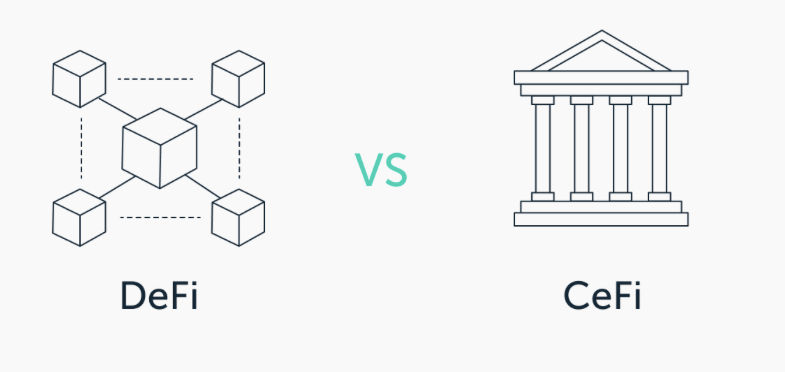
While blockchain technology has certainly democratized finance, it still operates in two forms - centralized finance (CeFi) and decentralized finance (DeFi). Both are equally important players in the cryptocurrency industry and make good use of the distributed ledger technology. Both concepts have evolved to solve separate challenges and continue to revolutionize the field.
CeFi Exchanges vs DeFi Exchanges
#1 Decentralization
DeFi, as the name suggests, is an entirely decentralized system, as it does away with any intermediaries. It is essentially an application of smart contracts to financial instruments. On the other hand, CeFi involves private companies or corporations. It mimics the legacy financial industry by enabling people to get loans or earn interest while using their cryptocurrencies as collateral. Therefore, these private companies act as lenders, bear custody of the deposited assets, and also bear the risk - much like traditional financial institutions. They act as intermediaries, and this makes the CeFi system rather centralized.
#2 Functionality
When it comes to functionality, CeFi exchanges do have an edge. In addition to regular functions like crypto trading, lending, borrowing, payments, and stable coins, CeFi setups also allow cross-chain exchange, fiat-to-crypto conversions and lucrative instruments like crypto derivatives - like Bitcoin futures, options, and more . Being able to convert fiat money to cryptocurrency is particularly useful for new users.As of now, DeFi exchanges lag in this respect as they do not allow fiat-to-crypto conversions and cross-change exchange.
#3 Philosophy
Worth admitting that CeFi exchanges, relying on a centralized architecture, are not in keeping with the philosophy of Bitcoin. Contrary to this, DeFi strives to offer a complete range of financial services to digital asset users and yet does not sacrifice the core tenets that underlie these assets.
#4 Transparency
In the case of transparency, the Decentralized Finance concept as a whole, wins hands down. On exchanges, the model enables pseudonymous transactions and does not require personal information to be registered, unlike CeFi. Since it is based on public blockchain platforms, it allows greater transparency as anyone can audit the transactions and even the code. Therefore, while information is accessible to all participants of the blockchain, individual piracy is still maintained.
#5 Accessibility
To access a DeFi exchange, all you need is a device with an internet connection. You could be located anywhere in the world and still access the DeFi system as long as you have these. But global adoption of decentralized finance has not been possible yet due to legal restrictions in some countries. A CeFi exchange, however, can be geographically restricted.
#6 Security Challenges
Source: Ledger
CeFi exchanges have a disadvantage since the custody of the assets lies with the company. Due to this high liquidity, they can become a target for hackers. There have been some major cases of hackers managing to walk away with massive amounts and consequently, users have lost their funds. But several CeFi exchanges have been prompt in securing their systems. Delta, for instance, has enterprise-grade security, stores crypto assets in multisig wallets, and processes withdrawals only once a day with manual review.DeFi exchanges are mostly non-custodial and users do not forfeit ownership of their assets, making them responsible for their own risk. But this does not mean that they are completely foolproof. Since these systems rely on code, any flaw in the code can result in disaster. This can be particularly concerning for newcomers because they may not be aware of the underlying risks of a protocol.
#7 Speed of Transaction
CeFi offers greater speeds of transaction as compared to DeFi. For example, Ethereum and Bitcoin networks can process 25 and 7 transactions per second respectively. Compare this with Visa, which can process 24,000 transactions per second.
#8 Popularity
Owing to its user-friendliness (generally superior UI/UX) and capacity to convert fiat currency, CeFi exchanges have achieved much popularity. CeFi exchanges are also leading when it comes to active trading, volumes, and liquidity. However, this is not to say that DeFi exchanges are particularly behind. In recent times, the DeFi ecosystem overall has been growing at a breakneck pace and might just catch up in the future.
CeFi exchanges vs DeFi exchanges: Conclusion
So which one is the better crypto exchange? The answer is tricky and honestly depends on the needs and preferences of users. When considering CeFi exchanges vs DeFi exchanges, it’s clear that both occupy their unique place in the crypto finance ecosystem and are heading towards more developments. Many cryptocurrency holders are not comfortable with the idea of forfeiting ownership of their crypto assets while others might prefer an exchange that allows fiat-to-crypto conversion while offering attractive interest rates. More recently, efforts are also being made to connect CeFi and DeFi.
Frequently Asked Questions (FAQ)
Q1: What is the difference between CeFi and DeFi exchanges?
Answer: CeFi exchanges are run by companies that hold your funds and match trades internally. DeFi runs on public blockchains where you keep custody throughout. The FTX collapse in 2022 illustrated how badly CeFi counterparty and insolvency risk can materialize.
Q2: How do CeFi and DeFi exchanges differ in terms of transparency and privacy?
Answer: DeFi protocols run on public blockchains, so every transaction is visible and auditable in real time. CeFi keeps order books and custody private. DeFi offers stronger on-chain accountability; CeFi requires KYC which reduces anonymity but adds regulatory oversight.
Q3: What are the security risks associated with CeFi and DeFi exchanges?
Answer: CeFi risks center on insolvency, hacks, and fund misuse. FTX in 2022 is the clearest example. DeFi carries smart contract exploits, flash loan attacks, and oracle manipulation. The risk categories are different, but neither model is risk-free.
Q4: How does the functionality of CeFi exchanges compare to DeFi exchanges?
Answer: CeFi platforms like Delta Exchange cover futures, options, margin, and spot trading with fast execution and deep liquidity. DeFi is permissionless and composable but still lags on derivatives depth and execution speed for most active traders.
Q5: Which is more accessible, a CeFi exchange or a DeFi exchange?
Answer: CeFi wins on accessibility. Fiat on-ramps, customer support, and familiar interfaces make it workable for most people. DeFi requires wallet setup, gas fee management, and smart contract literacy, which is a genuine barrier for anyone starting out.
Q6: How do CeFi and DeFi exchanges differ in transaction speed and performance?
Answer: CeFi matching engines execute in milliseconds. Ethereum L1 processes roughly 15 TPS, making DeFi slower and pricier under congestion. Layer 2 networks like Arbitrum and Base have cut costs sharply since 2024 but have not closed the execution speed gap.
Q7: Which type of exchange should a crypto trader choose, CeFi or DeFi?
Answer: For derivatives trading with leverage and INR settlement, a FIU-registered platform like Delta Exchange makes more practical sense for Indian traders. DeFi suits people who want self-custody and permissionless access, as long as they understand smart contract risks.